
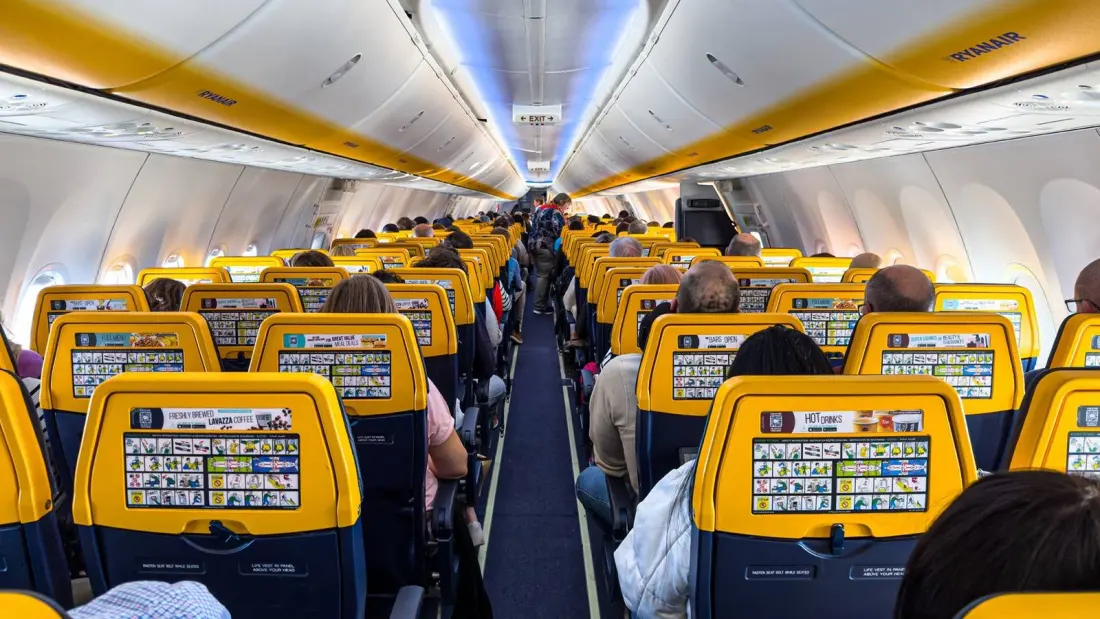
Ryanair carried a record 208.4 million passengers in its latest fiscal year and posted €2.26 billion in profit after tax — up 40% year on year — while offering some of the least comfortable flying in Europe. That's not a contradiction. The discomfort is the business model.
Start with the seats. Ryanair's cabins use lightweight, non-reclining plastic seats with no seatback pockets, no magazines, and safety cards printed directly onto the headrest. Stripping out recline mechanisms removes a common maintenance failure, cuts weight (and therefore fuel burn), and means crew can reset the cabin in minutes with essentially nothing to clean or restock. That feeds directly into the airline's signature 25-minute gate turnaround, where passengers deplane and board almost simultaneously. A plane only earns money in the air, and Ryanair squeezes more flight legs out of each airframe per day than legacy carriers can manage.
The same logic applies on the ground. Ryanair avoids expensive primary hubs like Heathrow and Brussels, flying instead from secondary airports such as London Stansted and Brussels South Charleroi, which offer lower landing fees and often subsidies. Planes park on remote stands and passengers walk across the tarmac using onboard airstairs — unglamorous in the rain, but it sidesteps jet bridge and terminal infrastructure costs entirely.
Then there's the pricing. The headline fare is essentially a loss-leader. Of €15.54 billion in total operating revenue, €4.99 billion came from ancillaries — bags, seat selection, priority boarding and the like — roughly 32% of revenue, or about €24 per passenger on top of the base fare. Because everything beyond a seat is unbundled and optional, the base ticket stays low while each traveller's actual spend creeps upward.
Fleet standardisation seals it. Ryanair operates a single aircraft family — now over 640 planes, including all 210 of its Boeing 737 MAX 8-200s, which pack 4% more seats at a 28-inch pitch while burning 16% less fuel. First deliveries of a 300-strong 737 MAX 10 order are slated for spring 2027, adding another 20% capacity per plane. One fleet type means cheaper training, maintenance and spares. Not everyone is cheering, though: the Italian competition authority hit the airline with a €255 million antitrust fine, and labour disputes over crew conditions have flared for years. None of it has dented demand — the airline is targeting 300 million annual passengers by 2034.
For travellers, the takeaway is simple: complaints and bookings live in separate worlds. Ryanair has proven that on short European hops, the lowest price beats legroom, tarmac walks and the absence of everything else. If you know the game — travel light, skip the extras, check which secondary airport you're actually flying from — you can cross the continent for less than a train ticket. If you don't, the extras will find you at checkout.