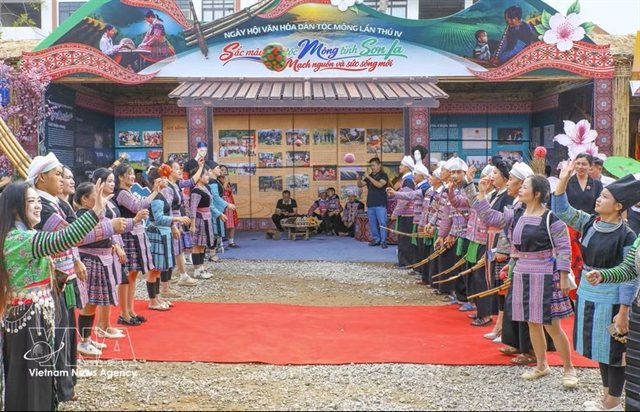
From October 9 to 11, the northern Vietnamese province of Điện Biên becomes the centre of Mông cultural life, hosting the fourth Mông Ethnic Culture Festival 2026. Artisans, performers and athletes from 11 provinces gather to show off crafts, music and games that have been handed down for generations — and visitors get a front-row seat.
The craft line-up is the heart of it. Expect demonstrations of linen weaving, embroidery, beeswax printing on fabric, blacksmithing, and the making of the khèn, the bamboo panpipes central to Mông music. Named artisans include Sùng Thị Xoà from Lào Cai and Giàng Thị Pó from Điện Biên, whose work shows just how much patience these techniques demand. There's bánh dày (pounded sticky rice cake) being made on site too.
Beyond the workshops, the festival turns into a fair of folk games and performance: pa pao ball throwing, tù lu spinning tops, stick pushing and tug-of-war, alongside folk songs, dances and traditional costume. Mông communities from across the northern highlands — including Sơn La — use the event as a friendly competition ground and a chance to keep traditions visible to younger generations.
Officials are explicit that this isn't just folklore for its own sake. Trịnh Ngọc Chung, Director of the Department of Ethnic Culture, framed the festival as a way to tie cultural preservation to sustainable livelihoods — tourism, handicraft sales and food experiences that turn heritage into income. That matters for travellers: the crafts and dishes you see here are increasingly the basis of community-based tourism in the highlands, so attending supports exactly the model that keeps these traditions alive.
For visitors, it's a rare chance to see 11 provinces' worth of Mông culture in one place rather than trekking across the region. Điện Biên itself is worth more than a stopover — the historic Điện Biên Phủ battlefield sites and the road routes into Lai Châu and Sơn La make it a good base for a northern Vietnam loop off the usual Hanoi–Sapa track.
October is also a smart time to be in the northwest highlands: the heavy rains have eased, rice terraces are at their golden best, and temperatures are comfortable for wandering festival grounds and mountain roads alike.
Anyone with an interest in textile arts should prioritise the beeswax printing and embroidery demonstrations — the patterns are specific to different Mông subgroups, and artisans are usually happy to explain the motifs. If you're travelling on, linen and indigo pieces bought directly here beat mass-market market souvenirs, though buying directly from a named artisan is the way to ensure money reaches the maker.
Practically, Điện Biên Phủ has a small airport with flights from Hanoi, but most international visitors will arrive via Hanoi and continue by road. Accommodation is simple but improving; book early if your trip coincides with the festival dates, as domestic visitors travel in numbers for events like this.
The fourth edition runs October 9–11, 2026, in Điện Biên province.