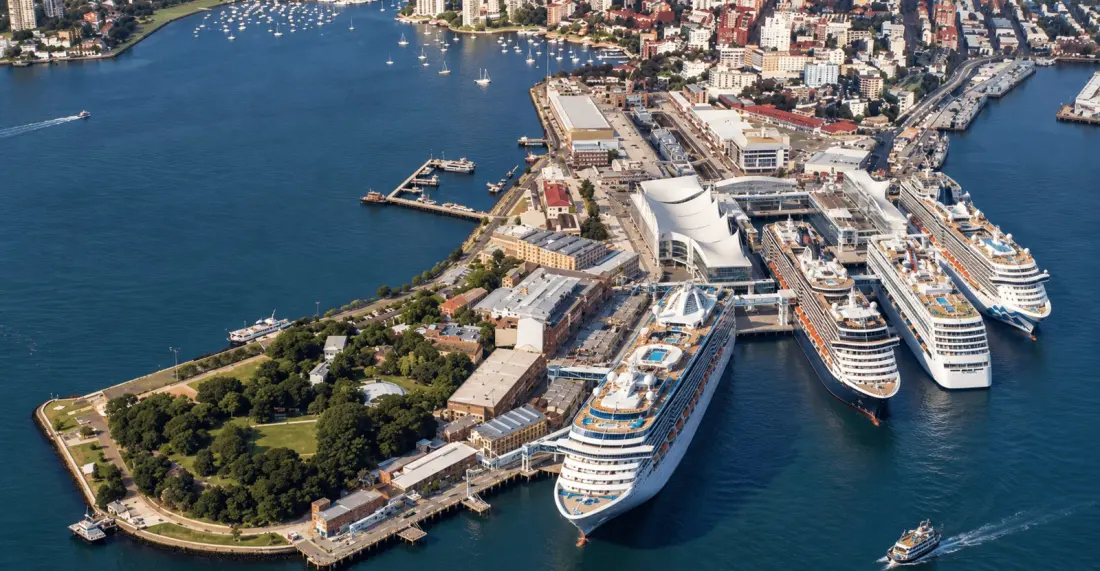
Sydney Harbour can only take one large cruise ship east of the Harbour Bridge at a time, and two years after the NSW Government set up a panel to fix it, there's still no answer. The Cruising Industry Advisory Panel, announced on October 18, 2024 by then transport minister Jo Haylen, was charged with finding a site for a new terminal, boosting capacity at the Overseas Passenger Terminal, and planning a possible third berth. Chaired by Port Authority chief Phil Holliday and stacked with executives from Royal Caribbean, Carnival Australia, Norwegian Cruise Line, Ponant and CLIA, it has so far produced no public recommendation.
The delay matters because the stakes are falling. Australia's cruise industry generated A$7.32 billion in output in 2024-25 and supported 22,720 jobs, with NSW taking the biggest share at A$3.94 billion and 12,408 jobs. But that output dropped A$1.11 billion, or 13.2 per cent, from the previous year. Cruise lines can berth their billion-dollar ships anywhere, and Sydney's capacity squeeze, especially White Bay's awkward position west of the bridge for the biggest new vessels, is pushing them elsewhere.
Cruise Passenger's editor-in-chief Peter Lynch points to Vancouver as the comparison that stings. Sailing into the Canadian city aboard Grand Princess, he watched four ships cycle through the downtown Canada Place terminals in a single day, including three berthed at once handling more than 10,000 passengers. That didn't happen by luck. Canada Place was a national project, begun in the early 1980s ahead of Expo 86, with a federal Crown corporation created to run it and roughly C$342 million invested in the original development. When Alaska cruising boomed, the cruise facilities were expanded around 2000 as passenger forecasts passed one million a year, with governments and private capital, including the Pan Pacific hotel, pouring in alongside.
Vancouver's 2024 numbers show the payoff: 1.3 million cruise passenger visits, 99 per cent of them turnarounds, C$800 million in direct spending and a total economic impact of C$1.4 billion. Lynch is careful not to overstate the comparison — Vancouver's business is fueled by Alaska, a destination shared across a border much as Sydney's homeport voyages span Australia, New Zealand and the South Pacific. But the underlying point stands: Vancouver decided cruise was infrastructure worth planning and paying for, while Australia's industry bodies are still lobbying for a coordinated national approach that hasn't arrived. Federal Tourism Minister Don Farrell's office reportedly declined repeated requests to meet, and a planned discussion with New Zealand's tourism minister never happened.
The one Sydney site with the deep-water geography to handle today's largest ships east of the bridge is Garden Island, a working naval base where any civilian use would have to respect Defence priorities first. Whether naval and cruise operations could share the precinct, or whether Port Kembla is the realistic fallback, is exactly the question the advisory panel was convened to answer. Two years on, travellers and an industry worth billions are still waiting to hear it.