Between 1991 and 1993, German photographer Hans-Peter Grumpe spent 83 days travelling across Vietnam during three consecutive summers, shooting thousands of frames of a country on the edge of opening up. His archive is now a time capsule: images of places that, within a decade, would be unrecognisable.
In Ho Chi Minh City, he photographed landmarks that still anchor any first visit today — the French-built City People's Committee headquarters, the Notre-Dame Basilica (completed in 1880 with every material shipped from France), and Ben Thanh Market with its four-faced clock tower. He also crawled through the Cu Chi Tunnels, the roughly 250-kilometre underground network about 70 km northwest of the city that once sheltered fighters, meetings and weapon caches.
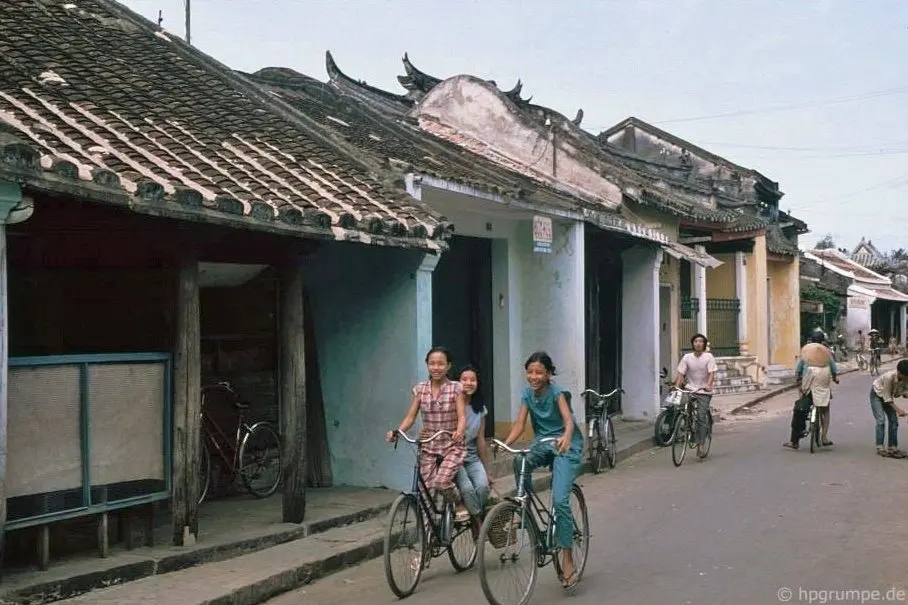
The central coast photos are the most striking contrast with today. In 1992, Nha Trang had almost no foreign tourists or modern hotels — its beaches sat empty except for locals. Da Nang's My Khe Beach was a raw shoreline where fishing village children swam and fishermen mended nets at dawn; there wasn't a sun lounger in sight, just stalls pouring hot green tea. Three decades later, Tripadvisor ranked My Khe sixth among Asia's top ten beaches. Hoi An, though officially on tourism maps since 1985, had no boutique hotels, cocktail bars or souvenir shops — just weathered timber shophouses (no uniform yellow paint yet) and lanes busy with bicycles and pedicabs. The Japanese Covered Bridge was moss-covered and unrenovated, falling silent at night under dim streetlamps.
In Hue, Grumpe shot nearly 100 frames, many of the Imperial Citadel begun by Emperor Gia Long in 1804 — then still scarred by wartime damage and humidity-stained masonry, decades before it became the centrepiece of a UNESCO World Heritage complex.
Further north, Hanoi moved at a slower, quieter pace than Saigon, its French colonial façades lining avenues like Trang Tien towards the Opera House. His two visits to Ha Long Bay bracketed a turning point: in 1991 the bay had a single state-run hotel; by 1993 private hotels and family restaurants were multiplying. In Ninh Binh he drifted through Tam Coc's limestone karsts by wooden sampan past farmers working rice paddies.
Sa Pa in 1992 barely registered in guidebooks. From 1993, the permit requirement for independent travellers was dropped, tour groups arrived, and the mountain town transformed into the resort hub it is now. His boldest trip came in July 1993: an overland run from Hanoi to Cao Bang in a Soviet UAZ jeep to reach Ban Gioc Waterfall — then absent from commercial routes, with no ticket booths or guesthouses, framed by primary forest. He hit it during monsoon, the river heavy with red silt and thundering water. Today Ban Gioc is recognised as Southeast Asia's largest natural waterfall and the world's fourth-largest on a border.
For travellers, the story is a reminder of how fast a destination changes — and why it's worth seeing places like Hoi An, Ha Long or Ban Gioc with an eye on their recent past. Much of what Grumpe photographed can still be visited; the experience, though, is nothing like the empty beaches and quiet lanes of his negatives.