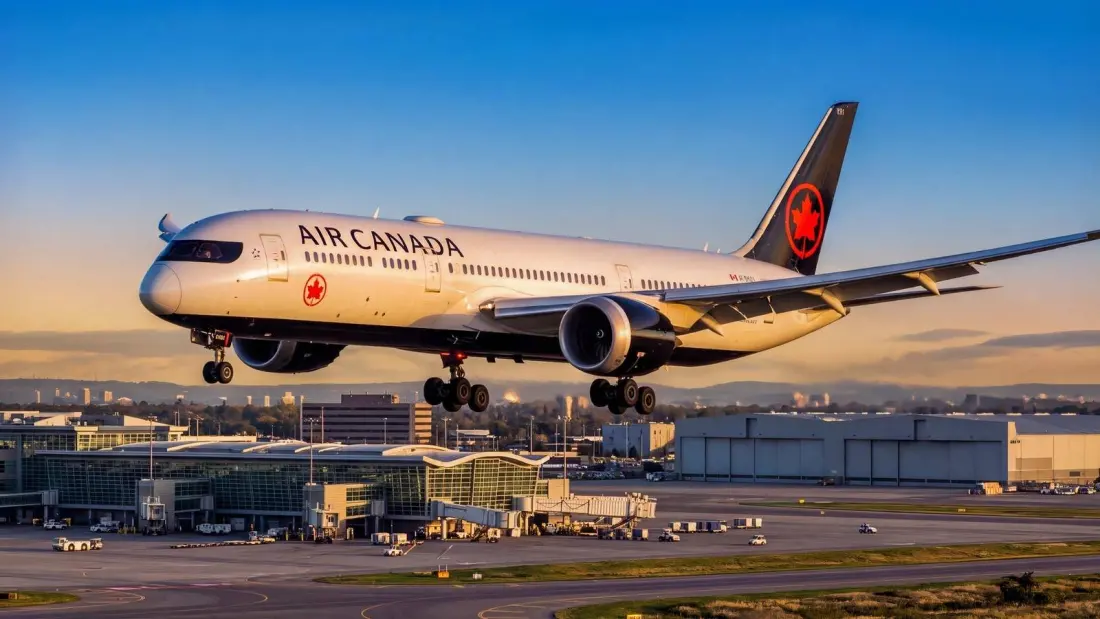
Air Canada is trimming its international network substantially, with Cirium schedule data showing eight routes set to disappear between May 2026 and early 2027. Two are long-haul; six are shorter international or US services. For travellers, it means some nonstop options that existed only recently are about to vanish.
The headline loss is Vancouver–Singapore, the carrier's longest nonstop flight at 6,923 nautical miles (12,821 km) each way, flown five times weekly on a 787-9. Service ends on January 24, 2027 — less than three years after it launched in April 2024, when Air Canada stepped in after Singapore Airlines pulled out of Vancouver in 2023. Ultra-long-haul economics are brutal, and high fuel prices appear to be the culprit. Booking data suggests most passengers on the route were actually connecting — an estimated 79% changed planes in Vancouver, Singapore, or both, with roughly 35% of the market transferring at Changi on Singapore Airlines codeshares. Meanwhile, Delta looks set to announce Seattle–Singapore, betting fuel prices will fall. Ironically, Air Canada had not flown to Singapore since 1991 before the 2024 relaunch.
The other long-haul casualty is Halifax–Brussels, which ran for just a single season using a 737 MAX 8, with its final departure on September 5, 2026. It was notable as the first-ever nonstop link from that market, but 35 departures apparently weren't enough to justify continuing.
Closer to home, Air Canada has fully exited New York JFK, dropping both Montreal–JFK and Toronto–JFK in May 2026. It still serves Newark and LaGuardia from both cities, and Delta remains on Toronto–JFK — but there's now no Montreal–JFK nonstop at all. Other cuts: Vancouver–Raleigh-Durham ends in July 2026 after barely a year; Toronto–Charleston, which in March 2024 became that city's first-ever nonstop service to Canada, finishes in September 2026 (US data shows only 66.3% of seats were filled there — soft demand tells its own story); Vancouver–Nashville also ends in September 2026, leaving that route unserved; and Toronto Billy Bishop–Boston, launched only in July 2026, is gone by November after a single season.
The backdrop matters: Air Canada's international flying in 2026 is down 19% versus its 2018 record, with US capacity sitting near a two-decade low, partly attributed to the political climate. It's offsetting some of the cuts with bigger planes — a record average of 171 seats per flight.
For holidaymakers, the practical takeaway is to book with care for late 2026 and 2027 travel. Vancouver–Singapore nonstop is about to become a connecting itinerary again, so travellers in Western Canada should compare one-stop options via other hubs or Singapore Airlines alternatives. Halifax loses its only European link, meaning connections through Toronto or Montreal for Brussels. And if you were counting on nonstops to Charleston, Nashville, Raleigh-Durham or JFK from those Canadian cities, expect to connect or switch airlines. Frequencies can shift again, so re-check schedules before locking in plans for next year.