Before the Boeing 747 became the plane that let millions fly long-haul for less, it was a gamble run at breakneck speed. Engineer Joe Sutter and the workforce nicknamed 'The Incredibles' took the jumbo jet from drawing board to rollout in roughly 29 months, with around 50,000 employees involved across the wider program. The National Air and Space Museum later called Sutter the 'Father of the 747'.
The scale of the challenge is hard to overstate. Pan Am wanted an aircraft carrying about two and a half times the passengers of the 707, and Boeing had no factory big enough to build it. So it constructed a new plant in Everett, Washington, starting in 1966, with workers assembling the first jet while parts of the facility were still unfinished. Sutter insisted engineers stay on-site beside the production line rather than move to California, arguing that designers needed to see how their decisions played out on the factory floor.
Many of the 747's defining features came from practical trade-offs, not styling. The famous upper-deck hump exists so freighter versions could have a forward-opening nose cargo door, a hedge against Boeing's expectation that supersonic jets would one day dominate passenger travel. The twin-aisle widebody layout, chosen over a stacked double-decker, set the template for every long-haul jet that followed. Four engines reflected the limits of 1960s technology and the rules of the day for overwater flights.
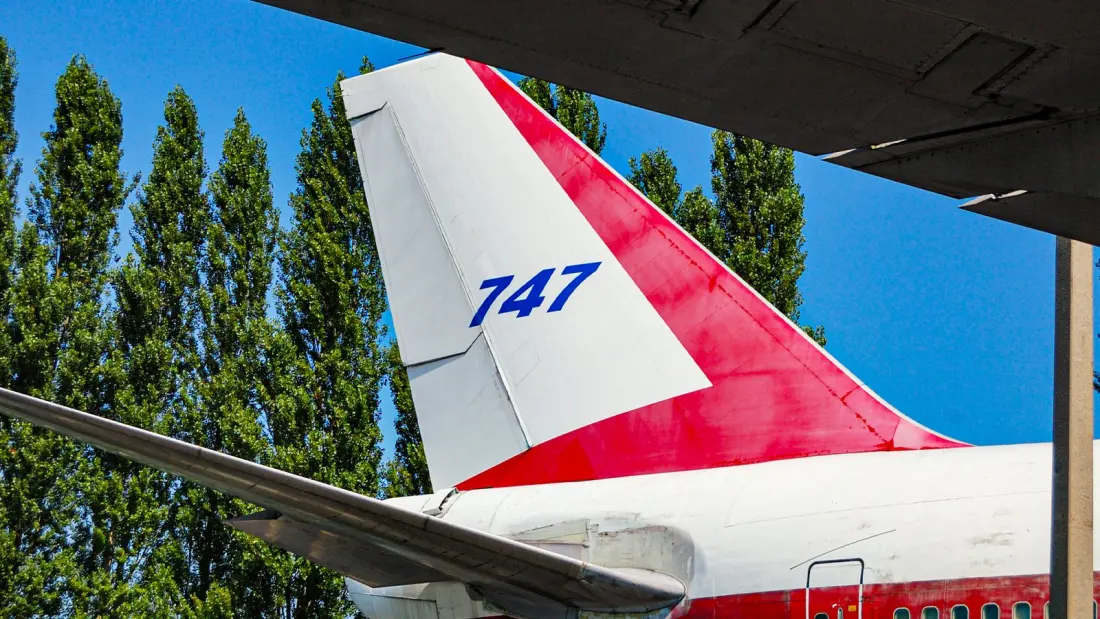
The prototype, later known as the City of Everett, first flew on February 9, 1969 from Paine Field with test pilot Jack Waddell at the controls, watched by thousands of Boeing staff in cold, slushy conditions. Pan Am launched commercial service between New York and London on January 22, 1970. Production ran an extraordinary 54 years, ending in 2023 with a 747-8 freighter delivered to Atlas Air. In total, 1,574 were built, logging over 118 million flight hours.
For travellers, the story has a physical home. The original prototype RA001 is preserved at the Museum of Flight in Seattle, and the Everett factory — still the world's largest building by volume — offers tours where you can see widebodies under assembly. Sutter retired in 1986 after four decades at Boeing and received the Smithsonian's Lifetime Achievement Trophy in 2013. His core lesson still shapes aviation: great aircraft come from keeping design and manufacturing tightly connected. If you're flying across an ocean today, the comfort of that wide cabin traces straight back to Sutter's team.
Via Simple Flying.