Yasushi Ogura has crossed between Japan and Việt Nam's northern highlands more than 100 times. First drawn to the country in 1995, the Tokyo-born former food-company manager began visiting the Hà Giang rocky plateau — now part of Tuyên Quang Province — regularly from 2002, and took early retirement in 2013 to focus on it fully. Now approaching 70, he has learned Vietnamese well enough to talk directly with residents of Lô Lô Chải, a village of the Lô Lô ethnic group near the Lũng Cú Flag Tower at the country's northern tip.
His interest began with the region's rammed-earth houses — thick-walled structures with yin-yang tiled roofs and stone fences — along with traditional dress and local customs. But by the time he arrived in Lô Lô Chải in 2011, he had noticed a problem. Old earthen homes can be damp and awkward, and concrete replacements look far more comfortable. Simply asking families to preserve inconvenient houses because tourists like the look of them was never going to work. So Ogura tried a different route: make heritage pay.
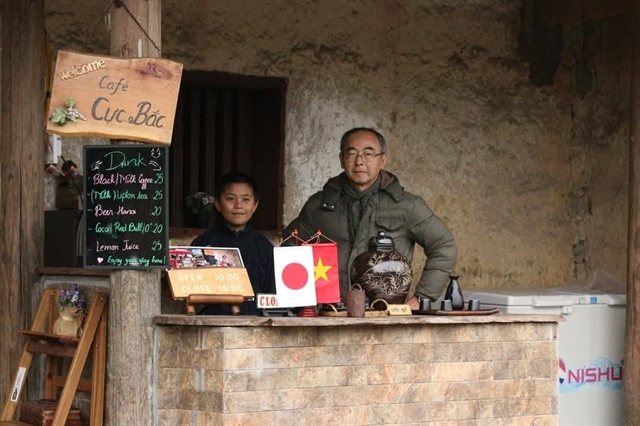
With VNĐ200 million (about US$7,700) from his own savings, he helped one family renovate part of their house, set up a coffee counter and improve sanitation, while volunteers from Hà Nội taught them how to serve customers. The result, Cà phê Cực Bắc (Northernmost Coffee), became a popular stop for travellers reaching the top of the country. Crucially, Ogura took no ownership stake and no share of the profits — the café stayed entirely with the family. That became his guiding principle: locals keep their homes, their cultural resources and the income from both.
It worked. The extra earnings reduced the family's reliance on farming and helped fund their children's education; their university-graduate daughter has since returned to help run the tourism business. Neighbours followed, opening homestays, selling handicrafts and cooking for guests. Ogura also warns of the opposite scenario: if outside investors buy up village properties, residents end up as employees on their own land. He is now working with local authorities on 'living museum' ideas for Mông communities, where people would keep living, farming, weaving and keeping bees in their rammed-earth houses while hosting visitors — with digital tools helping younger residents record elders' stories and promote homestays online.
For travellers, the story doubles as a guide to visiting well. Lô Lô Chải and the surrounding plateau are well set up for low-key cultural tourism: homestays in traditional houses, a distinctive café at the country's northernmost point, and daily life — weaving, cooking, farming — that visitors can observe without it being staged. Spending money with locally owned homestays and cafés, rather than outside-run operations, is exactly the model Ogura's work supports. And if you go, you'll see why he kept coming back for three decades.