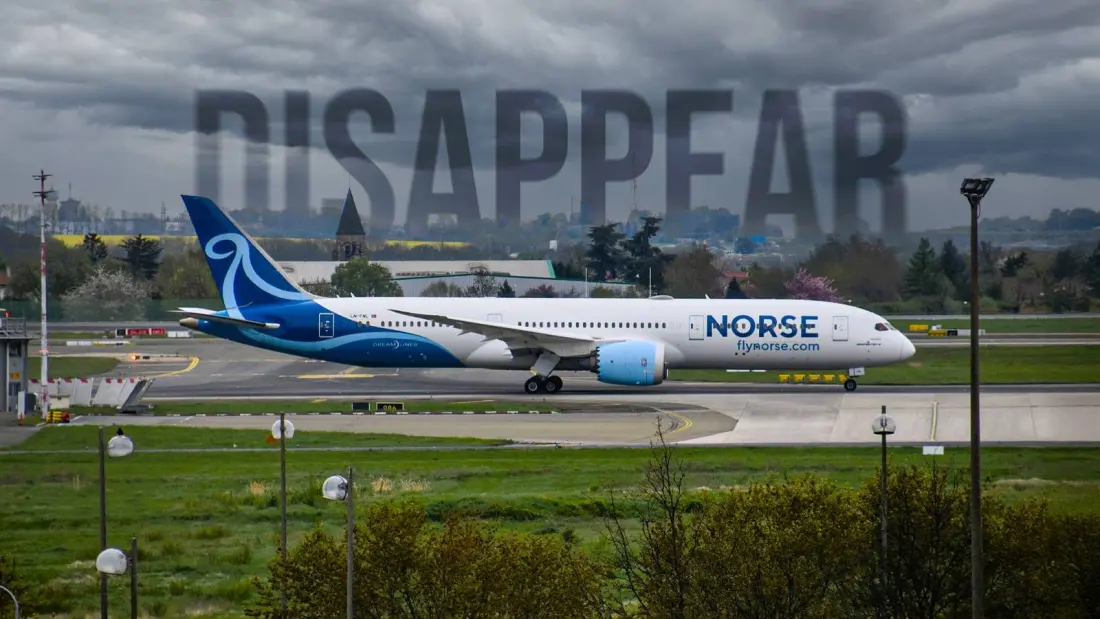
If you've been banking on Norse Atlantic for a bargain flight between Europe and New York, it might be time for a plan B. The Norwegian carrier has cut its transatlantic network from 12 routes at the height of summer 2025 to just four a year later, and its own numbers suggest more shrinkage could follow.
Norse's second-quarter 2026 results make grim reading. The airline filled 94% of its seats — better than the global average of around 84% — yet still posted an operating margin of -21%. Revenue per passenger rose 20% year-over-year to $447, but unit costs jumped far faster: cost per available seat kilometre climbed from 4.85 to 8.23 cents. In plain terms, Norse is attracting passengers and still losing money on nearly every seat kilometre it flies. Its share price has fallen almost 98% since late April 2023.
The problem is structural. Legacy airlines subsidise cheap economy fares with premium-cabin revenue; Norse, with only a small premium section on its 787s, can't. And the usual low-cost playbook — fast turnarounds, maximised aircraft use, secondary airports — doesn't translate to ten-hour sectors, crew rest rules, curfews and congested hub slots. Long-haul flying is simply expensive no matter how you dress it up, a lesson Norwegian Air Shuttle and Iceland's WOW Air learned before.
So Norse is pivoting. Six of its 12 Boeing 787-9s now fly ACMI contracts — leasing aircraft and crew to other airlines — with that revenue jumping from $6.1 million to $45 million in a single year. But its big deal with India's IndiGo ends in November 2026, and those jets will need new work. Meanwhile the scheduled network has been gutted: Oslo–New York, the route Norse launched on in June 2022, is gone, along with Berlin, Paris and Miami services, and planned Los Angeles flights were scrapped. What remains is London Gatwick–New York JFK, Gatwick–Orlando, Athens–JFK and Rome–JFK.
The growth story now lies elsewhere. For winter 2026/27, Norse is pushing long-haul leisure routes to Thailand and South Africa — up to five weekly flights from Oslo and Stockholm to Bangkok, plus Phuket services from several cities, and continued Cape Town flying. The company has a strategic review underway that could end in a sale or merger, and it's chasing up to $50 million in annual cost cuts.
For travellers, the takeaway is simple: Norse isn't disappearing overnight, but the rock-bottom transatlantic fares that defined it are becoming a side gig. Book its remaining US routes while they exist — and if you fancy its Bangkok or Cape Town flights, those are now the core business, priced accordingly.