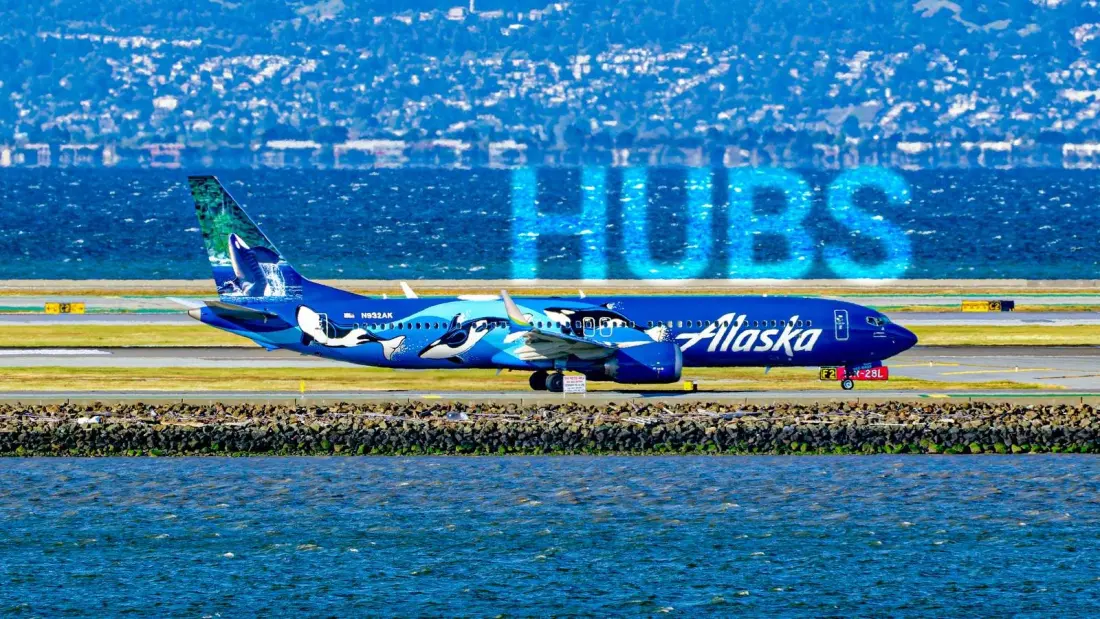
Alaska Airlines gets talked about as a Seattle carrier, and fair enough — Seattle-Tacoma is its biggest hub and the launchpad for its first long-haul international routes. But after absorbing Hawaiian Airlines and pushing hard up and down the West Coast, the group (now the fifth-largest airline in the US) operates six other hubs, and a couple of them are quietly huge.
The big change is Honolulu. Since the Hawaiian Airlines acquisition, Daniel K. Inouye International has become Alaska Air Group's second-largest hub, with the combined carriers holding roughly 47% of the market between July 2025 and June 2026. Under the Hawaiian brand you can still fly from Honolulu to Sydney, Tokyo Haneda and Osaka Kansai, plus a dense web of interisland and mainland routes. There's money behind it: more than $600 million is being invested across Hawaii over five years, and a new premium lounge for around 200 guests should open at HNL in early 2028.
Portland, the old number two, has slipped to third but keeps growing — over 130 daily departures in summer 2026 and 50% more seats than two years earlier, on roughly a 50% market share. A new 14,000-square-foot lounge opened in June 2026, and a new maintenance hangar is under construction.
California hosts four hubs. San Diego is the largest of them and the airline's fourth-biggest overall: nearly 3.1 million scheduled one-way seats in 2025, a 21.4% market share, more than 50 nonstop destinations and 8.4 million round-trip seats on sale for 2026 — up 35% on the previous record. Pilots are now based there, and a new lounge arrives in 2028. Los Angeles and San Francisco (inherited from Virgin America) rank fifth and sixth, with LAX especially strong on leisure routes to Cancun, Los Cabos, Puerto Vallarta and Liberia in Costa Rica. And then there's the namesake state: Alaska still commands about 70% of the market at Anchorage, with the ANC–Seattle route its busiest domestic pairing in 2025.
Why should a traveller care? Because the strategy shapes your options. The Accelerate plan is aimed squarely at keeping West Coast loyalists inside one network: long-haul capacity rising from about 8% to 15% by 2030, Seattle growing to at least 15 intercontinental destinations, premium cabins targeted at 40% of revenue by 2030, and new Aurora and Leihōkū premium products plus a true premium economy cabin on the way. If you fly between California, the Pacific Northwest, Hawaii and now Asia or Australia, your booking choices are about to get a lot more interesting — especially with oneworld partners filling the gaps.
For flyers on the ground, the practical wins are the lounges (Anchorage's just doubled its seating to 140 as part of a $60 million state investment plan) and the competitive fares that come with Alaska and Southwest battling it out in San Diego, one of the fastest-growing aviation markets around.