Scientists have revealed what a man who lived in the Ecuadorian Andes more than three millennia ago actually looked like — and handed the reconstruction to the communities who live there now.
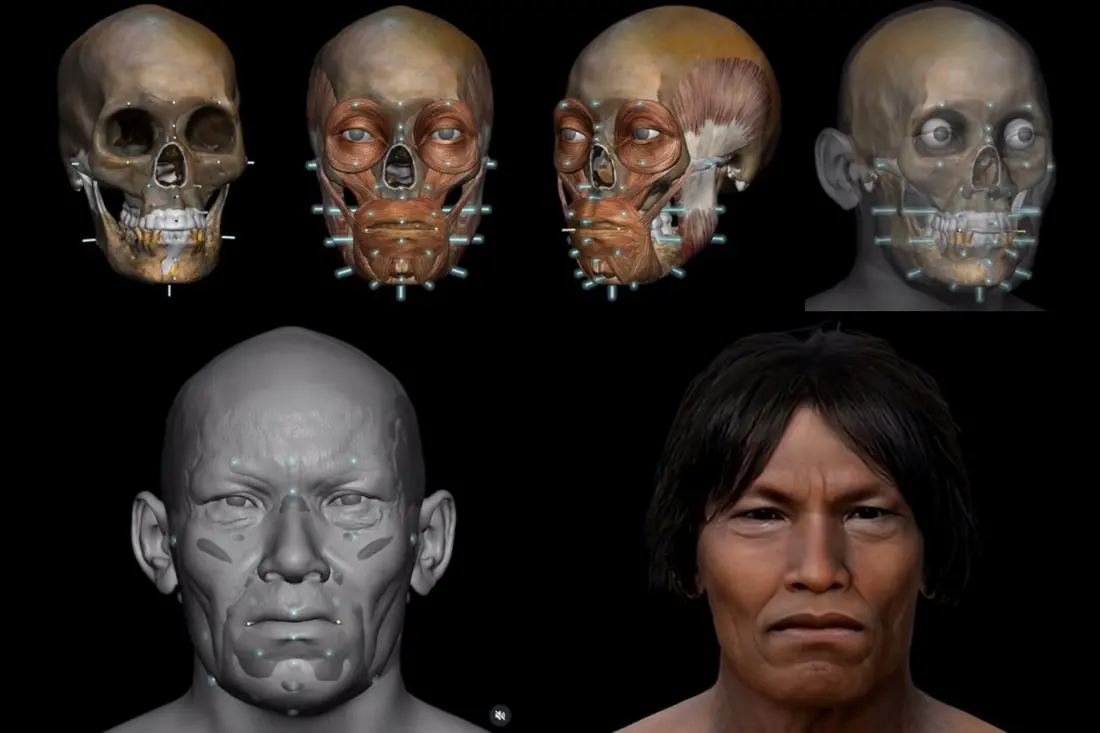
Forensic anthropologist Christopher Rynn, working with researchers at the Universidad Nacional de Chimborazo (UNACH), rebuilt the face from the skull of an individual known as Punin-2. He called the result a portrait of the modern population's actual ancestor. Local teams had excavated the skull in 1974 from a ravine near Punin, in Chimborazo province, following an earlier discovery there in 1923 by an American Museum of Natural History expedition.
Punin-2 is described as an Indigenous American hunter-gatherer who was around 50 when he died. A bone fragment found nearby suggested an age of roughly 3,190 years, though the skull itself hasn't been directly dated yet — that's on the team's to-do list. The site's geology once muddied the waters: the ravine also holds Ice Age fossils from mastodons, prehistoric horses and giant ground sloths, which led early researchers to think the human remains were equally ancient. Later geological studies showed sediment movement had mixed younger human remains with far older animal bones, and a 1980 reassessment placed the skulls in the Holocene, within the range of early Indigenous American populations.
The reconstruction used the Manchester Method — digital modelling combined with tissue-depth measurements — with the skull's own 3D shape as the guide. What bone can't tell you is hair or eye detail, so the team turned to regional ceramics from the Regional Development period and, notably, to local people in Chimborazo today. The result: black hair parted in the middle, with features informed by how contemporary residents interpret their ancestor's appearance. Rynn noted the hairstyle mattered especially because it carried cultural distinctions between regional groups.
The project started in 2025 with backing from Ecuador's National Institute of Cultural Heritage, and the Escuela Superior Politecnica de Chimborazo 3D-scanned the skull. Next up: a physical model with real hair in 2027, DNA analysis of both skulls, and — pending fundraising — a reconstruction of Punin-1, which currently sits in New York at the American Museum of Natural History.
For travellers, this is a reason to put Chimborazo on the map beyond its famous volcano. The region is home to Ecuador's highest peak, snow-capped Mount Chimborazo, and the town of Riobamba makes a natural base. The Punin find adds a human thread to the area's natural wonders — a reminder that the Andean communities you meet here have roots running back thousands of years.
Story via Colombia One.