
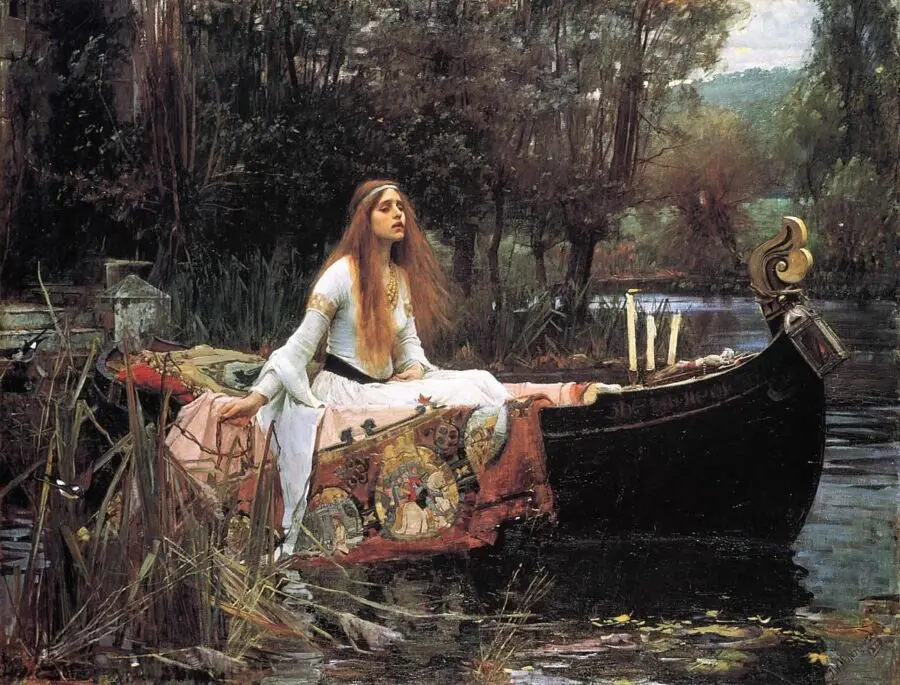
A woman in a white gown drifts down a dark river, lips parted, one candle still burning on the prow of her boat. She knows exactly where she's headed — and it's not anywhere good. John William Waterhouse's "The Lady of Shalott" is one of the most haunting paintings in British art, and one of the most rewarding stops for any art-loving traveller in London.
The painting retells a legend set near King Arthur's Camelot. The Lady has spent her life locked in a tower, forbidden from looking at the outside world directly — only its reflection in a mirror. When the knight Lancelot rides past and she dares to glance at him for real, the curse kicks in. She boards a boat and floats toward Camelot and her death. Waterhouse captures that moment of no return: the falling autumn leaf, the dim lantern, the tapestry she wove in captivity, the two dead candles beside one still alight.
What makes it striking is the restraint. Waterhouse worked in the spirit of the Pre-Raphaelite Brotherhood, the Victorian group that rejected the polished conventions of their day in favour of vivid colour, medieval romance, and literary subjects. The Lady's face — modelled on the artist's own wife — barely registers emotion. Instead, the mood comes from the details: the inky water, the reeds, the darkening sky, the luminous reds and blues that glow like stained glass.
There's a nice irony, too. The scene looks thoroughly medieval, but Waterhouse painted it at the height of the Industrial Age, when Britain was leading the world in trains and electric light. Victorian audiences knew the story intimately from Tennyson's best-selling poem, and each viewer read something different into it: the pursuit of truth over comfortable illusion, or love pursued at any cost.
For travellers, this is exactly the kind of painting that rewards seeing in person — the colours and fine detail don't fully translate on a screen. You can find "The Lady of Shalott" at Tate Britain on Millbank in London, alongside the largest collection of Pre-Raphaelite work anywhere, including paintings by Dante Gabriel Rossetti, John Everett Millais, and Edward Burne-Jones. It pairs well with a walk along the nearby Thames — fitting, given the painting's subject — or a day trip onward to Tennyson country or the Arthurian sites of the West Country. If your trip is more about the story than the canvas, Tennyson's poem is short enough to read on the flight over.
Admission to Tate Britain's main collection is free, so there's no excuse to skip it, and the gallery sits a short ride from Westminster and the South Bank. For anyone who thinks a gallery visit is a rainy-day fallback, this painting makes the case that it can be the centrepiece of a trip — a single image that opens up Victorian art, Arthurian legend, and one of England's great poems all at once.
Story via Rick Steves.