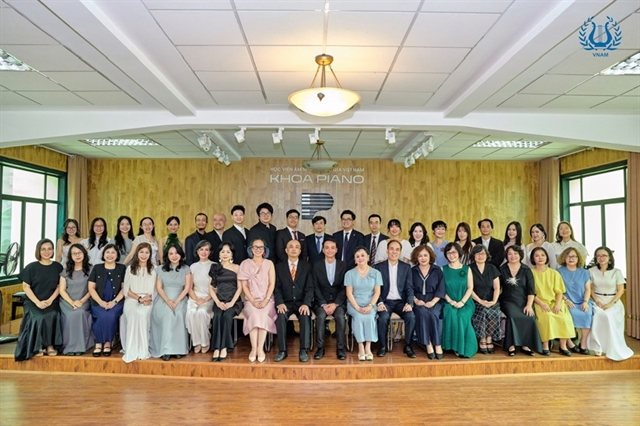
On 1 November, the Vietnam National Academy of Music (VNAM) in Hanoi stages something you rarely see anywhere: a four-piano concert featuring 32 of its own piano teachers, playing orchestral classics arranged for a quartet of grands — all to mark the academy's 70th birthday.
The programme swings wide. Mozart's Symphony No. 40, Glinka's Ruslan and Lyudmila overture, Mendelssohn's A Midsummer Night's Dream, Smetana's Vltava and Tchaikovsky's Nutcracker suite all get the four-piano treatment. Eight musicians team up for the Toreador Song from Bizet's Carmen, arranged by Edmund Parlow, and Gershwin's Rhapsody in Blue brings a shot of jazz into the hall.
There's a premiere too: young Vietnamese conductor Dustin Tiêu has created a new four-piano arrangement of Richard Addinsell's Warsaw Concerto — the sweeping piece written for the 1941 film Dangerous Moonlight — which will be heard publicly for the first time at this performance.
Homegrown music gets equal billing. Composer Đặng Hữu Phúc's Suite for Four Pianos, with its movements Dance and Highland Market, is the only piece on the bill originally written for this format, folding Vietnamese folk melodies into a contemporary piano language. Phúc is a big name locally — he took the Jinjue Award for Best Music at the 2005 Shanghai International Film Festival.
The performer list reads like a family tree of Vietnamese piano. Associate Professor Nguyễn Huy Phương, the academy's director, and Piano Department head Dr Đào Trọng Tuyên both play, alongside artists Nguyễn Hoàng Phương and Lưu Đức Anh. Professor Trần Thu Hà, a former VNAM director, appears in two groupings with different artist partners.
The anniversary angle gives the evening real weight. The Piano Department dates to 1956, when it helped found professional piano training in Vietnam despite scarce instruments and resources. Its story is bound up with the late People's Artist Thái Thị Liên (1918–2023), one of VNAM's seven founders, who taught and wrote curricula through two decades — much of it during wartime — and trained the country's first generation of concert pianists. One of her students was her own son, Đặng Thái Sơn, who in 1980 won the International Chopin Piano Competition, still the moment that put Vietnamese classical musicians on the world map.
For travellers, this is the kind of event that makes a Hanoi stop memorable. The academy sits near the Opera House in the French Quarter, an area worth wandering anyway, and a ticket here costs a fraction of a Western concert hall while delivering performances of genuine pedigree. If you're in Vietnam in early November, it's a rare chance to hear Vietnamese music history and European repertoire share one stage — on four pianos at once.
Story first reported by Vietnam News Life.