Verona gets typecast as the Romeo and Juliet city, but this northern Italian gem has more than 2,000 years of history that has nothing to do with Shakespeare. Its entire historic centre, set along the River Adige, has been a UNESCO World Heritage Site since 2000, and the layers are everywhere you walk.
Start with the Romans. The Arena di Verona on Piazza Bra is a first-century amphitheatre that still does what it was built for: hosting crowds. Every summer since 1913 it has staged an opera festival, and seeing a performance under the stars inside a Roman monument is one of Europe's great ticket buys. Elsewhere, the Porta Borsari city gate, the Ponte Pietra bridge and the hillside Roman Theatre fill out the ancient picture.
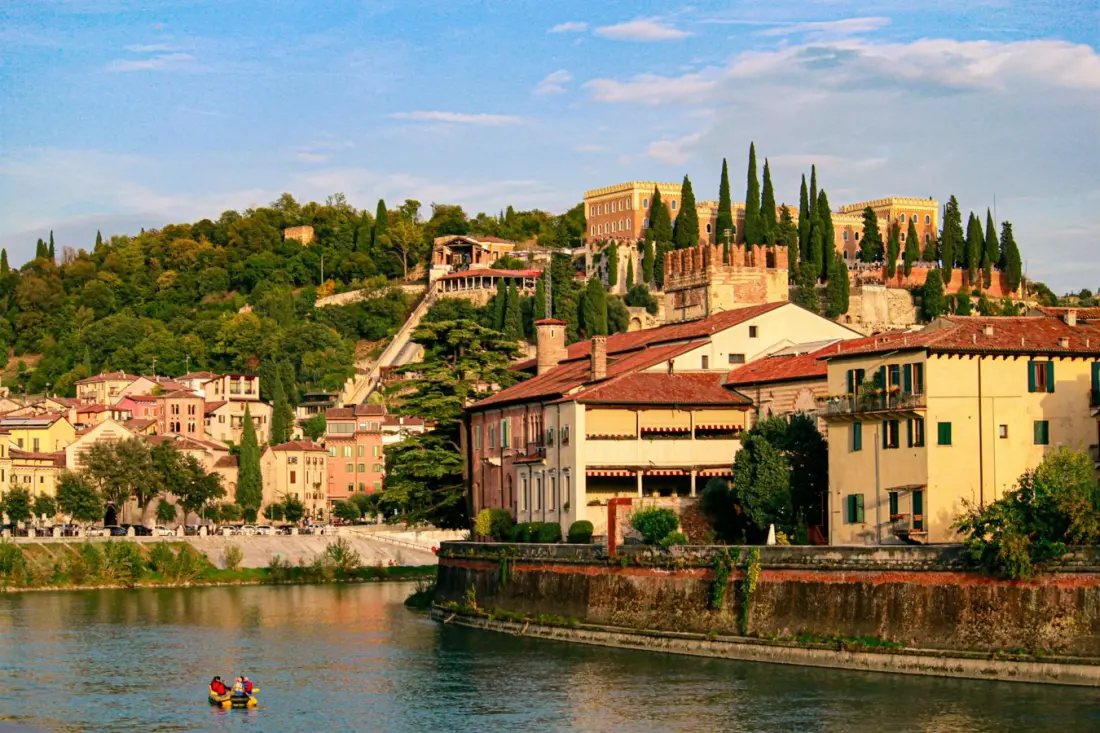
The medieval era belongs to the Scaliger family, whose 14th-century Castelvecchio now houses an art museum, with the fortified Ponte Scaligero spanning the river beside it. For the best panorama, climb to Castel San Pietro above Ponte Pietra, where terracotta rooftops fold around the river's bend.
The city's living heart is its squares. Piazza delle Erbe, once the Roman forum, mixes frescoed façades, market stalls and cafés where locals still meet over coffee. Quieter Piazza dei Signori nearby is framed by palaces tied to Verona's political past. Cross the river for Giardino Giusti, a Renaissance garden with cypress avenues, fountains and terraced viewpoints over the rooftops — a calm counterpoint to the crowds.
Then there's the food. Verona's signature dish is risotto all'Amarone, made with Vialone Nano rice and Amarone wine from the nearby Valpolicella hills, giving it a deep colour and rich flavour. Risotto al tastasal, with seasoned pork sausage, is another local staple, and gnocchi gets its own celebrations during Carnival. Wine lovers can extend the trip into Valpolicella's vineyards, where Amarone is produced.
As for Juliet's House, the courtyard and balcony are fun if you love the play, but the connection is literary tradition, not documented fact. Treat it as one stop among many — the real Verona is the amphitheatre, the bridges and the plate of risotto waiting at the end of the day.
It's a compact, walkable city that rewards travellers who give it two or three days, especially those who time a visit around the summer opera season or pair it with Venice and the Veneto wine country.