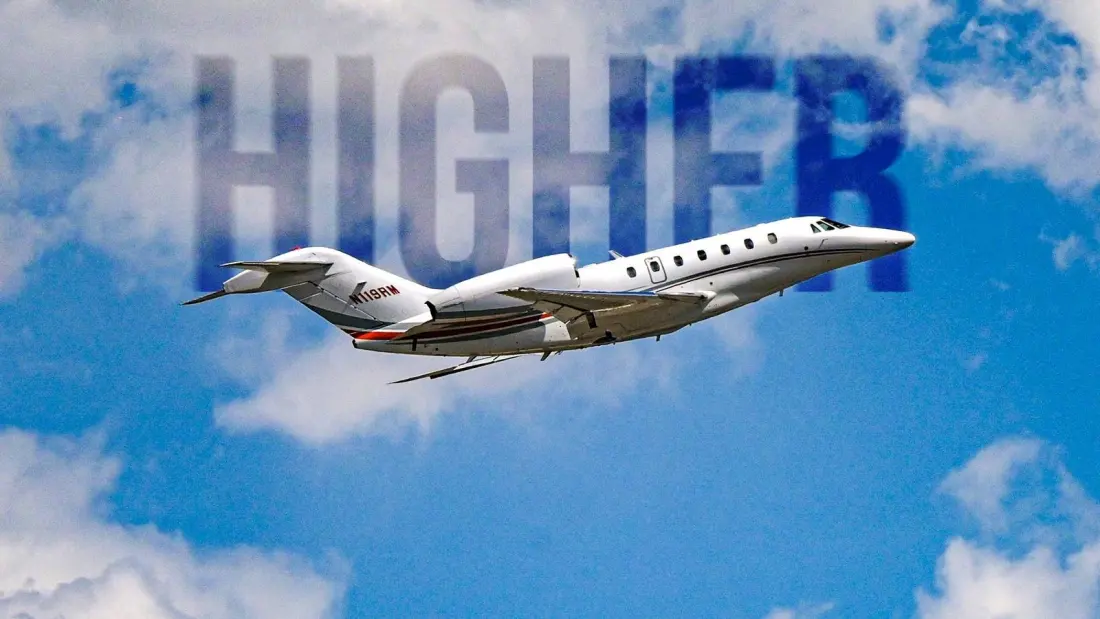
Commercial airliners have barely changed their cruising habits since the Jet Age. They fly between roughly 30,000 and 43,000 feet — the sweet spot where thin air cuts drag without starving engines of oxygen. Above that band, though, you'll find another world of traffic: long-range private jets certified as high as 51,000 feet, including the Gulfstream GVI and GVII, the Bombardier Global family, and some Dassault Falcons.
There's a popular claim that these jets burn 10-15% less fuel per mile by cruising up there. The truth is more nuanced. Higher altitude does mean less drag, but the real story is that jets like the Gulfstream G700 are deliberately engineered for it. They carry enormous wings relative to their light weight — the G700's wing area is nearly the size of an Airbus A319's despite being far lighter — and they use engines with modest bypass ratios, like the Rolls-Royce Pearl 700 at 6.5:1, versus around 9.6:1 for an A350's Trent XWB. They also typically depart lightly loaded. All of this makes them efficient up high, but per-mile they're still thirstier than an airliner, which is built to move heavy loads as cheaply as possible.
So why fly at 51,000 feet? Time. There's almost no traffic up there, so private jets fly more direct routes and avoid congestion, cruising at Mach 0.85 to 0.95 — faster than most airliners. That saves minutes or hours on every leg, which is precisely what private aviation customers are paying for.
That's the point the economics often miss: the appeal of flying private isn't really the cabin. A modern first class suite can out-luxury most business jets. What first class can't do is leave when you want, skip the terminal, and get you from car to airborne in minutes. The premium buys control of your schedule — and cruising higher compounds that time advantage.
There's also a regulatory ceiling keeping airliners where they are. Certification rules require aircraft to demonstrate an emergency descent from their service ceiling after a depressurisation, and that's why the 747-8 tops out at 43,100 feet while earlier 747s were certified to 45,100 feet — its descent rate was slower. Even without such constraints, airlines have no incentive to climb: fuel efficiency, not speed, drives their bottom line.
For travellers, this is a useful reality check in both directions. If you're chartering a jet, know that you're buying flexibility and speed, not guaranteed comfort or green credentials — these planes are less fuel-efficient overall. And if you're flying first class on an airline, you're getting the comfort but not the schedule control; the two products simply solve different problems.