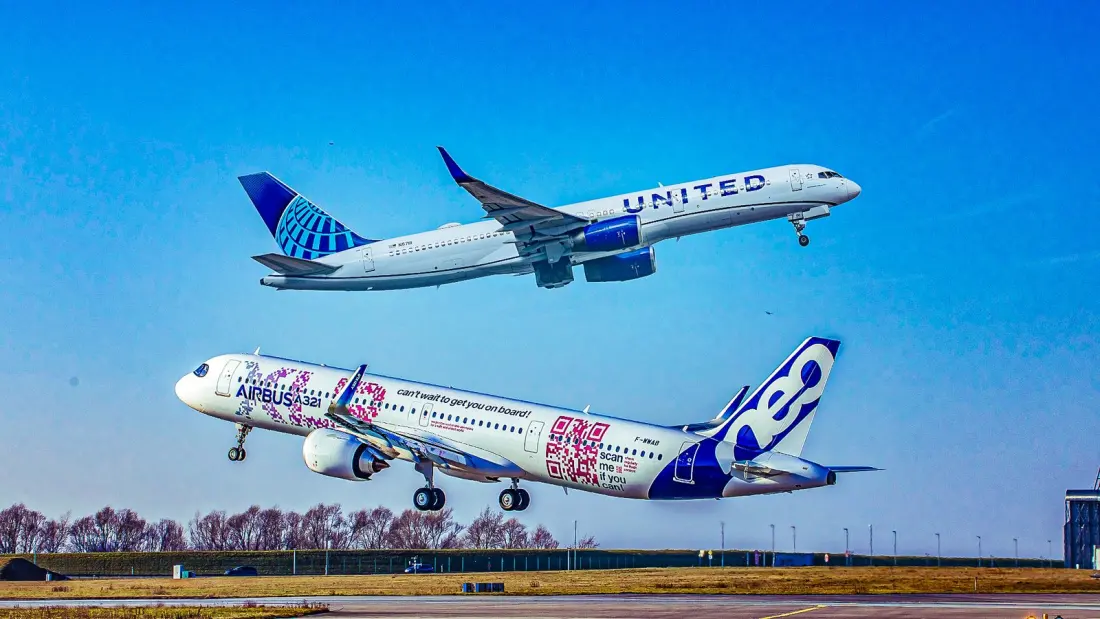
The Boeing 757 has been quietly defying retirement. Delta still operates 92 of them, by far the world's largest passenger fleet, with United holding 61. Both carriers are buying the Airbus A321neo family as the modern successor, yet the old Boeing keeps hanging on — and the reasons are worth understanding, because they shape which routes you'll fly on which aircraft for years to come.
The 757 was a one-off. Big wing (about 1,851 square metres versus roughly 122 for the A321neo), punchy engines, and a thrust-to-weight ratio around 0.34 gave it take-off performance that narrowbodies still struggle to match. That mattered at places like Newark and Dublin, where runway length and surrounding obstacles eat into how much weight an aircraft can haul. The A321XLR needs roughly 7,900 feet of runway at maximum take-off weight — about 1,400 feet more than the 757. Hot, high-altitude airports compound the problem: thinner air and high temperatures can force airlines to trim passengers, cargo, or fuel from an A321neo departure.
Range is the other gap. The A321XLR's headline figure of 5,400 miles looks impressive on paper, but real-world payload, weather and reserves shrink it. United has publicly suggested the XLR won't fly as far as Airbus originally marketed — an uncomfortable gap between brochure numbers and airline schedules. Seat count is a third issue: the stretched 757-300 carried more passengers than any A321neo, so replacing it can mean adding frequencies, with all the extra airport fees and crew costs that implies.
So why switch at all? Money. The A321neo burns roughly 20-30% less fuel per seat than a 757-200, and over thousands of flight hours a year that's a huge saving. Newer engines and cabins help too. Delta's 757 fleet has dropped from 127 in October 2023 to 83 by August 2026, though some jets will likely fly into the 2030s. United took its first A321XLR in June 2026 for transatlantic work, using it to serve thinner routes that can't justify a widebody.
For travellers, the practical takeaway is that your next '757-style' transatlantic flight will probably be on an A321XLR — quieter, fresher, more efficient — but on routes with short runways, tough climates or heavy loads, the veteran Boeing may still be waiting at the gate.