One of Vietnam's smallest national treasures is now one of its most visible. A pure gold box holding a genuine Buddha relic — crystallised remains after cremation — has gone on permanent public display at the Nghệ An - Xô Viết Nghệ Tĩnh Museum in Vinh, after a formal gallery opening on November 17.
The box itself is tiny, just 8x5x5.5cm, but its story runs deep. It was unearthed in 1986 at the Tháp Nhạn relic site in Nam Đàn (now Kim Liên commune), and bricks found at the site carry a date corresponding to 632 AD, under the Tang Dynasty. That makes the reliquary and its context nearly 1,400 years old — a rare marker of Buddhism's early arrival in north-central Vietnam. Craftsmanship is the draw: stylised lotus motifs cover the body, while the roof-shaped lid is worked with six-petaled chrysanthemums. Inside sit ash and two thin, opaque white pieces that archaeologists identified as the relics themselves. The state designated it a National Treasure in 2017, and its image has already appeared on a 2021 stamp series dedicated to Vietnamese gold objects.
The new gallery is built around the experience as much as the artefact. The glass display case is topped with pagoda-style curves, warm red and yellow wall treatments echo a temple interior, and incense smoke, Buddhist chanting and lighting effects set a contemplative mood. A transparent LED screen behind the case cycles through magnified views of the box from multiple angles — useful given that a lot of the detail would be invisible to the naked eye at this size. A companion exhibition, Buddhism in Nghệ An through antiquities, rounds out the visit.
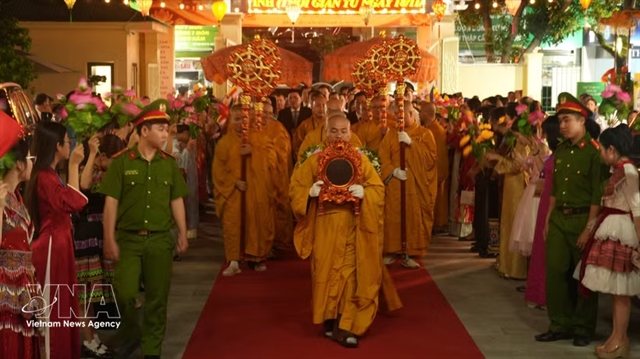
The opening came with spectacle. The same day, the province staged a procession of the treasure through Vinh's streets, with a police escort and a convoy of 108 electric cars carrying Buddhists and residents. It formed part of the 2026 Ethnic Groups Culture and Unity Week, running November 17-24 under the theme Cultural Flow - Strength of Solidarity, which brought heritage, art, food and tourism events to venues across the city.
Why should travellers care? Nghệ An remains one of Vietnam's less-visited provinces, better known as the route north to Hà Nội's hinterland than as a destination in itself. This gallery gives Vinh a genuine cultural anchor — a nationally recognised artefact you can see up close, in a deliberately atmospheric setting, free of the crowds you'd face at Vietnam's headline sites. It pairs neatly with other region draws: Kim Liên is also home to sites tied to Hồ Chí Minh's birthplace, and the coast at Cửa Lò is a short drive away. If you're driving the Ho Chi Minh Highway or hopping between Hà Nội and Huế, Vinh is now worth an overnight stop.