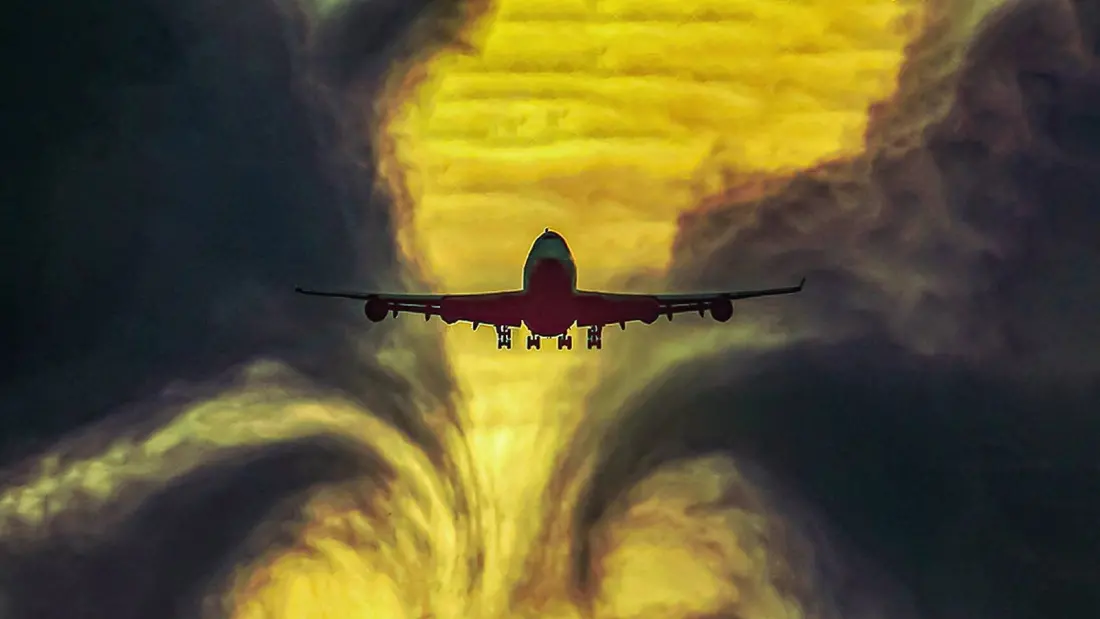
A sudden lurch at 35,000 feet and most passengers reach for the same explanation: the plane hit an air pocket. Aviation folk have news for you — those don't exist. There are no vacuums or holes in the sky for aircraft to drop through, and the myth has been around since the days of open-cockpit biplanes, when early pilots felt a downdraft and assumed they'd flown into a patch of empty air.
What actually causes that stomach-flip sensation is turbulence, most dramatically a form of windshear — a fast change in wind speed or direction over a small patch of sky. If a headwind suddenly weakens or the plane enters sinking air, it loses airspeed and lift, and descends. A classic example is the microburst under a storm cloud, which hits a plane in three nasty stages: a headwind that boosts lift, then a downdraft, then a tailwind on the way out that drains airspeed again. Pilots train specifically for it, and it's most dangerous because it happens at low altitude.
Everyday turbulence has plenty of other sources. Mountains can send ripples of air thousands of feet up. Cities and large buildings stir the flow at low level. On hot sunny afternoons, thermals rising off warm ground produce the bumpiness people wrongly associate only with bad weather — cumulus clouds are a telltale sign. Wake turbulence from the wingtips of larger aircraft matters mostly at busy airports, and small aircraft feel it worst.
The genuinely unsettling one is clear-air turbulence. It sits above roughly 15,000 feet, often near jet streams, and shows up on no standard weather radar. Pilots can't always warn cabin crew and passengers to buckle up in time. Recent incidents on record include crew injuries on an Airbus A330 near Loxton, South Africa in 2024, a diverting Boeing 737 over the Pyrenees in 2015, and even a belted passenger who broke a rib on an A320 in Okayama, Japan in 2022. Seatbelts remain the single best defence — plenty of injuries happen to people who are up and about.
There's also a trend worth knowing: University of Reading researchers have linked climate change to a 55% increase in turbulence in some regions, as stronger jet streams and shifting temperatures intensify windshear and clear-air turbulence. Hawaii routes have been hit hard — a December 2022 A330 flight injured 24 people, and moderate-or-greater turbulence over the Hawaii/West Coast region is reportedly up 30%. In late October 2024, a United Airlines 777 flying from Honolulu to Los Angeles dropped over 3,000 feet in about a minute, hospitalising one flight attendant, while all 190 passengers walked away fine.
For travellers the takeaways are simple. Turbulence is uncomfortable, not a safety crisis — aircraft are built to handle far worse. Keep your seatbelt fastened whenever you're seated, not just when the sign is lit. And if someone next to you blames an air pocket, you can gently set them straight: the sky has chop, but no holes.