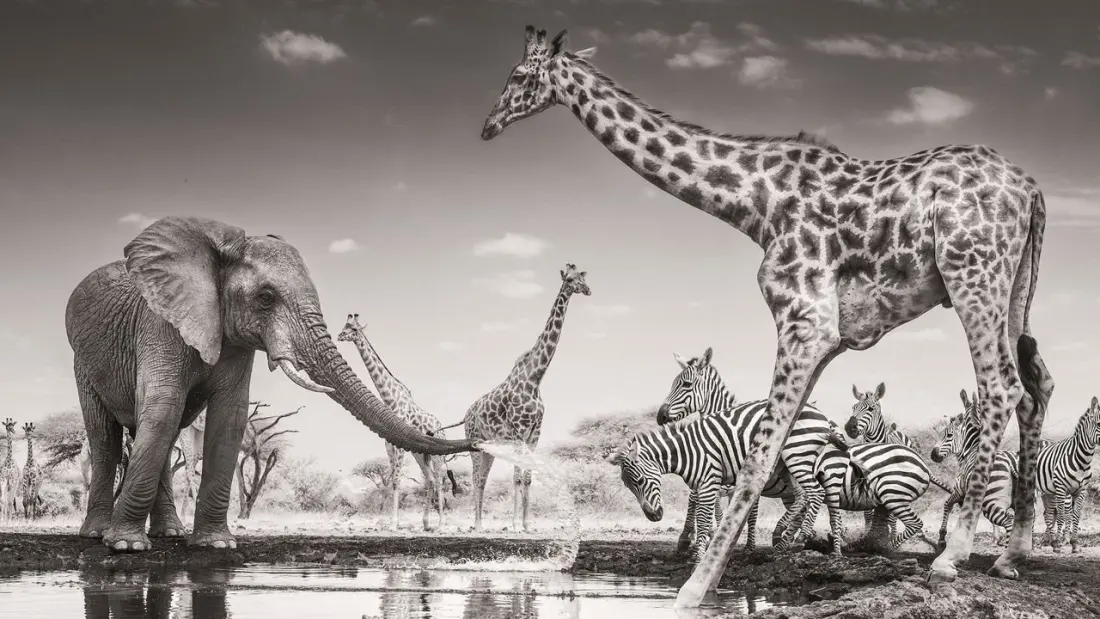
The Natural History Museum has announced the winners of the 62nd Wildlife Photographer of the Year competition, and for the first time in its history, both top prizes went to black-and-white images.
Italian photographer Federico Veronesi took the overall adult title for The Aftermath, a striking shot of a female elephant carrying her dead calf through the Huab River Valley in Namibia. Jury chair Kathy Moran called it emotionally devastating and, at the same time, evidence that animals think and feel. It's a heavy image — and exactly the kind that has made this competition the most-watched wildlife photography contest in the world.
The young category went to Oscar Whitfield for Labour of Love, a high-shutter-speed capture of a dung beetle straining to push its ball of cargo, shot with unusually high light sensitivity for such a small, fast-moving subject.
The numbers behind the win are staggering: 65,403 entries poured in from 121 countries and territories, with only a small handful making the final cut as winners, runners-up and finalists. The selected images span everything from microscopic slime molds to giant mammals — a reminder that award-worthy wildlife subjects exist at every scale, not just on safari.
For travellers, the winning images will be on show in the museum's long-running exhibition in London from 16 October 2026 to 11 July 2027, with tickets already on sale. After the London run, the show sets off on a global tour, so there's a decent chance it will stop in a city near you.
Why does a photography competition matter to holiday planners? Because images like Veronesi's point directly to the places they were made. Namibia's arid northwest, where the Huab River cuts through Damaraland, is one of the few regions where desert-adapted elephants still roam — and seeing the winning photograph tends to plant the seed for the trip. Even if you never make it to Namibia, the exhibition itself is a reason to visit South Kensington, and it pairs neatly with the museum's other galleries for a full day out.