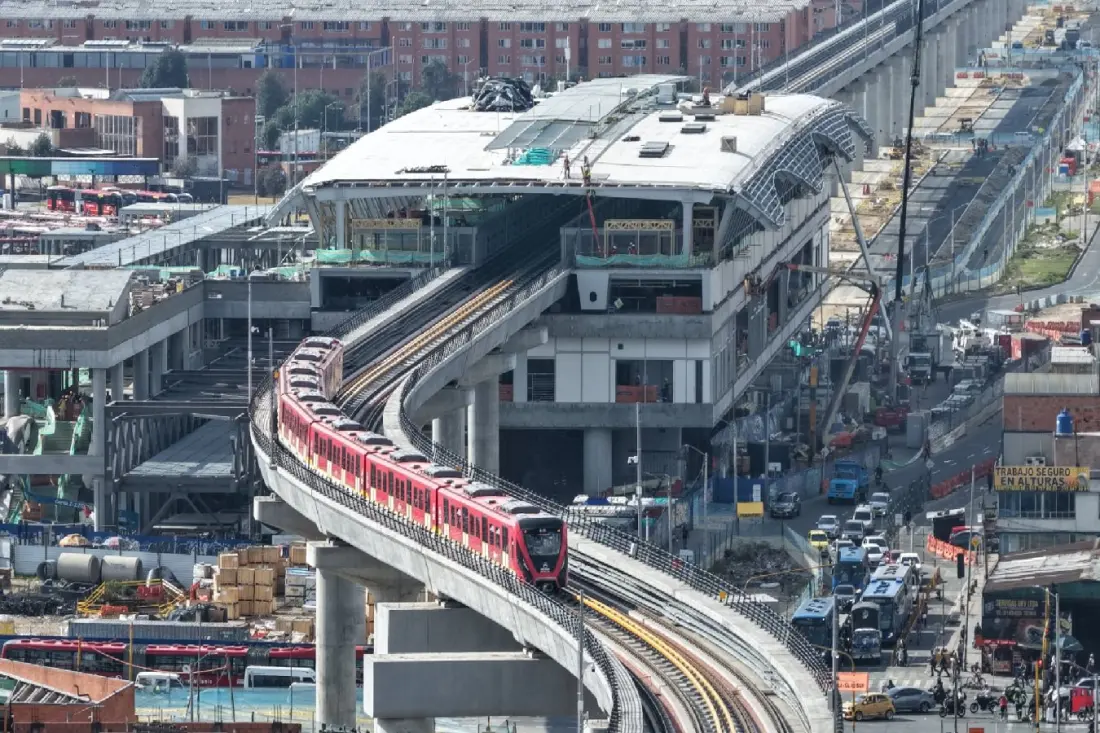
Bogota's long-awaited first metro line is now 83.73% complete, according to Mayor Carlos Fernando Galan, with stations 1, 2 and 3 showing finished facades and interior work underway. Nineteen trains are already being tested on the viaduct and at the depot, and a twentieth has just arrived in Cartagena for the trip inland to the capital. On the surface, Colombia's biggest infrastructure project looks to be cruising toward completion.
Behind the progress reports, though, a serious money fight has broken out. The consortium supervising the works has filed a formal request for amicable composition with the Bogota Chamber of Commerce against the Bogota Metro Company, after direct negotiations failed. Its claim: administrative decisions taken to keep construction moving after delays by the building contractor effectively rewrote the financial deal it signed, leaving it to absorb the cost of extra staff from its own pocket.
The supervisor says it shelled out more than 25.2 billion pesos — around US$7.9 million as of July 2026 — for additional payroll and service-contract personnel, plus mounting financial costs, without compensation. At the heart of the dispute is Supervision Contract 148 of 2020 and a domino effect that began when the concessionaire, Metro Linea 1 S.A.S., failed to deliver the detailed studies and designs on time. The Metro Company declared the contractor in breach through Resolution 374 of 2023, then signed Transaction Agreement No. 1 in July 2023 allowing construction to start before the designs were fully approved — a deal the supervision consortium says was struck without its input, stretching design deliveries across the build phase and keeping its engineering team on the job for nearly a year longer than planned, all outside its fixed monthly fee.
For visitors, the takeaway is simple but useful: the metro still isn't running, and this legal wrangling is a reminder that timelines can slip further. Bogota remains heavily dependent on TransMilenio buses and a crowded street network, so anyone visiting in the meantime should build generous buffers into cross-town journeys, especially at rush hour. Areas near the future line — running from the city's southwest toward the centre — are seeing visible construction, with the usual lane closures and diversions. The silver lining: when it does open, the line will finally connect travellers arriving at El Dorado airport's corridor with key districts far faster than today's bus options.
Whether the dispute ends in settlement or arbitration, the physical works are clearly close to done — the trains are on the tracks and being tested in public view. But for a project that has been promised to Bogota residents for decades, this latest spat over who pays for whose delays is one more reason to treat any grand opening date with a degree of caution.