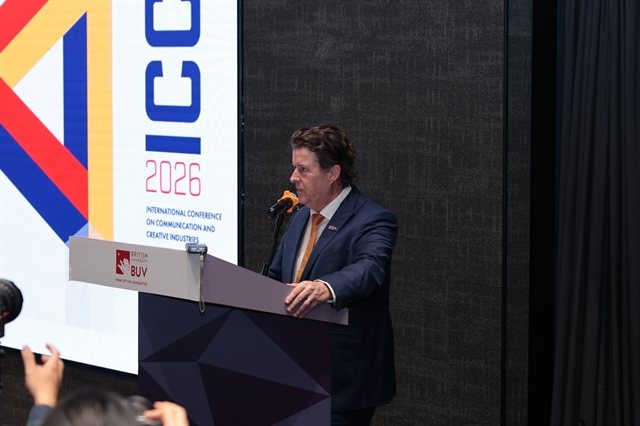
Hanoi's creative education scene got a two-day moment in the spotlight this week, as the British University Vietnam (BUV) opened its second International Conference on Communications and Creative Industries at its Ecopark campus in Hưng Yên Province, just outside the capital.
ICCCI 2026 drew close to 100 researchers and early-career scholars from 35 universities and institutions across Việt Nam and beyond, with participants from the UK, Thailand, Malaysia and Hong Kong joining the mix. The theme — 'Global Creative Industries: Power, Participation and Platforms' — put artificial intelligence, digital platforms and shifting audience behaviour at the centre of the discussion.
The talks went well beyond abstract theory. BUV's Vice-Chancellor, Professor Rick Bennett, pointed to the Vietnamese government's targets for cultural industries to reach 7 per cent of GDP by 2030 and 9 per cent by 2045, arguing that AI should assist human creativity rather than replace it. He also flagged an interesting hiring insight: the gap between graduates and employers is mostly about interpersonal skills, not technical ones.
One strand that will resonate with anyone who has travelled through Việt Nam was the push to turn the country's cultural heritage — its crafts, cuisine and storytelling traditions — into intellectual property with genuine international reach. Lê Quốc Vinh, CEO of Le Group of Companies, argued those rich resources need better commercial and creative systems if they're to find global audiences without losing their local character.
Animation got its own reckoning. Roland Vongphasouk of Xilam Vietnam, a studio that contributes to international animation projects, said Việt Nam needs to climb the value chain — from producing content for other people's brands to creating, co-producing and owning original stories. Meanwhile, BUV's Dr Ross Williams made the case for 'listening literacy', noting that sound is often ignored in media studies, and raised thorny questions about whose voices and accents end up in AI voice-training data — and who profits.
Alongside the talks, BUV signed memoranda of understanding with Le Group of Companies, Shuttlerock Vietnam and Xilam Vietnam, formalising ties between higher education and the creative sector.
So why should a traveller care? Partly because this is the machinery behind the culture you actually encounter on a trip — the animated films, ads and stories that shape how Việt Nam presents itself to the world. If the country does move from production house to storyteller, the food, festivals and folk tales visitors come for will increasingly reach screens far beyond its borders. The conference is also a sign of Ecopark, the green township where BUV sits, quietly building itself up as a place where education and culture intersect — a detour worth knowing about if you're based in Hanoi with a free day.