
Qatar has quietly stacked up a serious collection of buildings by some of the biggest names in design, and Doha now sells architecture as a reason to visit in its own right. Here's what to see and where.
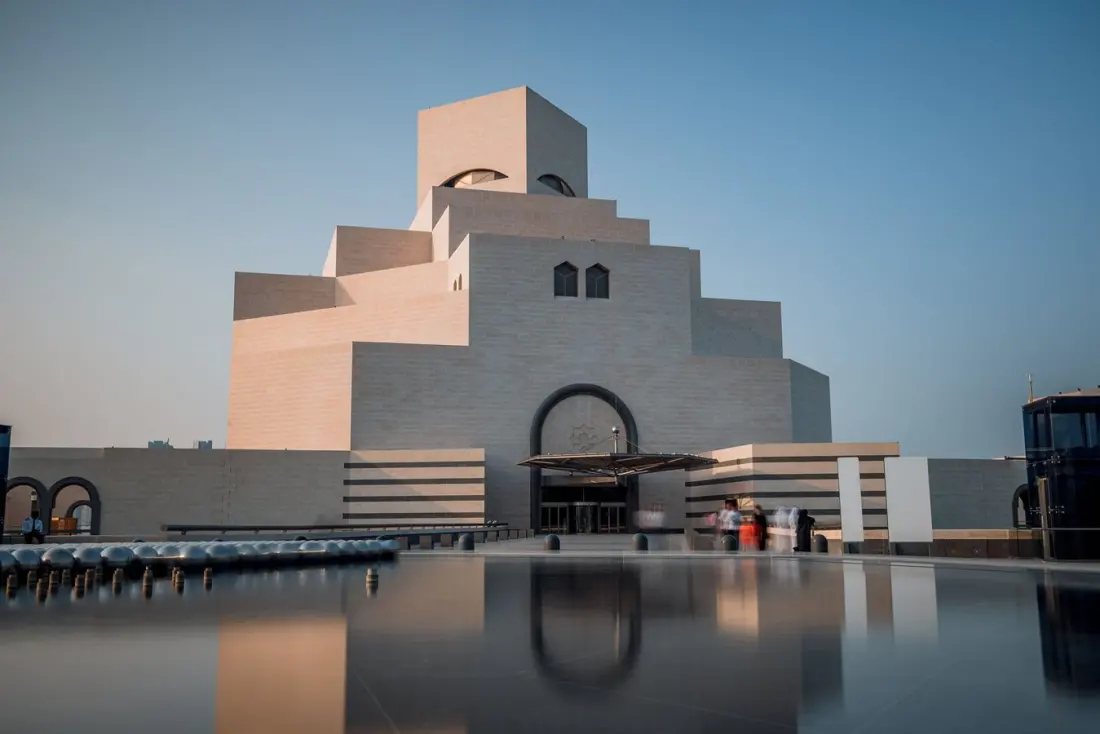
Start at the Museum of Islamic Art, which sits on its own island in Doha Bay. I. M. Pei — the man behind the Louvre pyramid — based its form on a 9th-century ablution fountain at Cairo's Mosque of Ahmad Ibn Tulun. Inside is a collection spanning 1,400 years, including the thousand-year-old Shahnameh manuscript by Ferdowsi, one of the world's earliest navigational astrolabes, and a 16th-century carved emerald plaque.
A short walk along the Corniche brings you to Jean Nouvel's National Museum of Qatar, a stack of interlocking discs modelled on the desert rose. The exhibits are as eye-catching as the shell — most famously the pearl carpet of Baroda, commissioned in 1865 by the Maharajah of Baroda and stitched with more than 1.5 million pearls plus diamonds, rubies, emeralds and sapphires.
For a different pace, wander Msheireb Downtown Doha, billed as the world's first sustainable downtown regeneration project. Its walkable streets mix traditional Qatari design with modern green building, and the heritage-house Msheireb Museums trace the country's social history. Barahat Msheireb, the region's largest covered open-air square, comes alive in the early evening once the heat drops.
Skyscraper fans should head to West Bay. Doha Tower wears a cladding pattern inspired by the traditional Islamic mashrabiya screen; the Tornado Tower twists like a desert whirlwind; the hexagonal Palm Tower mimics a palm tree in glass; and Barzan Tower blends old and new.
Two of the best sights lie outside the city. Near the UNESCO-listed town of Al Zubarah, Olafur Eliasson's 'Shadows travelling on the sea of the day' scatters 20 circular shelters and mirrored rings across the desert in a pentagram shape, playing tricks with sky and horizon. Even further northwest, in the Brouq Nature Reserve, Richard Serra's 'East-West/West-East' lines up four steel plates, each over 14 metres tall, across a kilometre of gypsum plateau — perfectly level with the land.
Round things off at Education City with Rem Koolhaas's Qatar National Library, a single vast open hall where terraced bookshelves rise like an amphitheatre and a sunken gallery displays rare Arabic manuscripts, old maps and navigational instruments. It's been compared to a landed spacecraft, and the comparison sticks.
Who's this for? Anyone who likes their culture walkable and photogenic: the highlights cluster within a compact city plus a couple of rewarding desert day trips, and entry to most sites is inexpensive. Pair the museums with the Corniche at sunset and you've got a long weekend that feels genuinely different from the usual Gulf stopover.