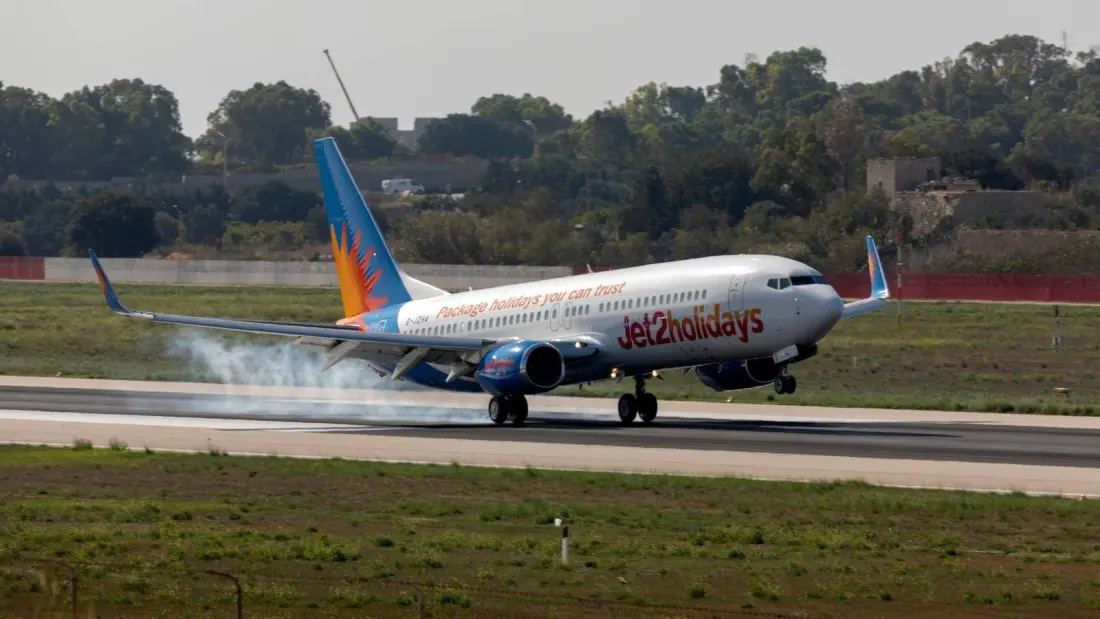
A Jet2 Boeing 737-800 carrying holidaymakers home from Venice ended up on the grass beside the runway at Birmingham Airport on Sunday, October 25, 2026, after a gusty landing that was caught on camera and quickly spread across social media. Nobody was reported hurt, but the incident shows how much difference a storm can make to an ordinary European beach-city flight.
The aircraft was operating flight LS1310 from Venice Marco Polo to Birmingham, touching down on Runway 33 at roughly 14:19 local time. According to Jet2, quoted by the BBC, the plane "temporarily moved off the runway" due to what the airline called exceptional weather conditions caused by Storm Boelo. Weather data from the airport tells the story: winds from the west at 18 knots gusting to 29 knots earlier in the day, with forecasts of gusts up to 45 knots through the afternoon and ground-level gusts around 42 mph. Because Runway 33 points roughly northwest, westerly winds hit it largely as a crosswind — the kind of condition that pushes an aircraft sideways at the worst possible moment, during touchdown.
Storm Boelo swept across the UK over the weekend of October 24–25, with the Met Office flagging the most severe winds in Scotland, Northern Ireland and northern England, where gusts of 60–70 mph were expected and up to 80 mph in exposed spots. Birmingham sat south of the worst of it, but the West Midlands still faced a windy afternoon — enough to complicate landings and ground operations alike.
For pilots, crosswind landings are a routine but demanding part of the job. Gusts and sudden shifts in wind direction force constant corrections on final approach, and every aircraft type has certified crosswind limits that crews must respect. Airports have their own playbook too: switching runway configurations, slowing arrival rates, holding departures or diverting flights when conditions get out of hand. Ground crews also take extra care loading and servicing aircraft in high winds.
The aviation angle aside, the broader message for travellers is simple: autumn storms in the UK can ripple through flight schedules quickly, even on routes far from the storm's centre. If you're flying into or out of Britain between October and March, booking morning flights when possible, keeping an eye on Met Office warnings, and knowing your airline's rebooking options are all worth the few minutes it takes. Birmingham itself remains a handy alternative gateway to London's crowded airports for Midlands-bound travellers, with Jet2 using it as a major base for its 737 leisure network — flights that continue as normal outside of storm days.
The landing footage makes for dramatic viewing, but the formal cause will only be established from operational data and weather records. Until then, it stands as a reminder that the scariest part of a flight is often the last thirty seconds — and that modern aircraft and their crews handle far worse than most passengers ever realise.