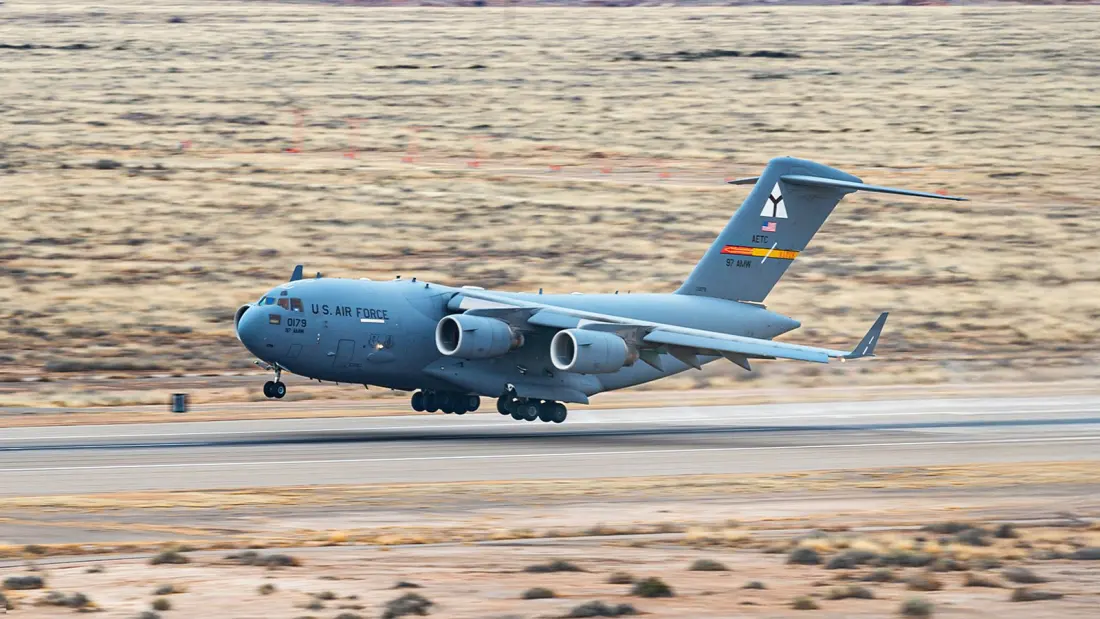
The McDonnell Douglas C-17 Globemaster III has been the workhorse of US strategic airlift since 1991, and its career spans everything from dropping paratroopers behind enemy lines to carrying scientists to Antarctica. Five missions in particular show why this jet has no real rival.
Built to bridge the gap between the massive C-5 Galaxy and the nimble C-130 Hercules, the C-17 pairs four Pratt & Whitney F117 engines with externally blown titanium flaps that nearly double wing lift. That lets a 290-ton jet slow to approach speeds of 115-130 knots and land on short, rough strips — a capability that shaped some remarkable flights.
On 26 March 2003, Operation Northern Delay marked the jet's combat coming of age: 17 C-17s flying blacked-out at night from Aviano Air Base in Italy delivered 996 paratroopers of the 173rd Airborne Brigade onto Bashur Airfield in northern Iraq. The following fortnight saw the type land Abrams tanks and Bradley fighting vehicles on a 6,700-foot runway, moving 2,175 personnel, 408 vehicles and over 3,000 tons of cargo.
Its softer side is just as striking. Every southern summer, C-17s fly from Christchurch, New Zealand to McMurdo Station in Antarctica under Operation Deep Freeze, delivering over 100,000 pounds of supplies per flight onto sea-ice runways. When an earthquake shattered Port-au-Prince in 2010, the jet's upward-firing thrust reversers let it back out of parking spots without tugs — and one aircraft airdropped 40 pallets in a single pass. After Typhoon Haiyan hit the Philippines in 2013, loadmasters stripped the seats and strapped more than 670 evacuees to the cargo floor for a flight from devastated Tacloban to Manila.
The record came on 15 August 2021. Reach 871, a Globemaster at Hamid Karzai International Airport in Kabul, was swamped by civilians fleeing the Taliban as the airport perimeter collapsed. With no time for a weight-and-balance check, the crew departed for Al Udeid in Qatar carrying 823 Afghan passengers — the heaviest passenger load any C-17 has ever flown.
Why should a traveller care? Because the routes and airports you use — Christchurch as the Antarctic gateway, Manila as an evacuation hub, Qatar's Al Udeid as a strategic crossroads — are shaped by this aircraft's reach. And the engineering behind it, from blown flaps to 14-wheel landing gear, is a genuine marvel if you're ever lucky enough to see one at an airshow.