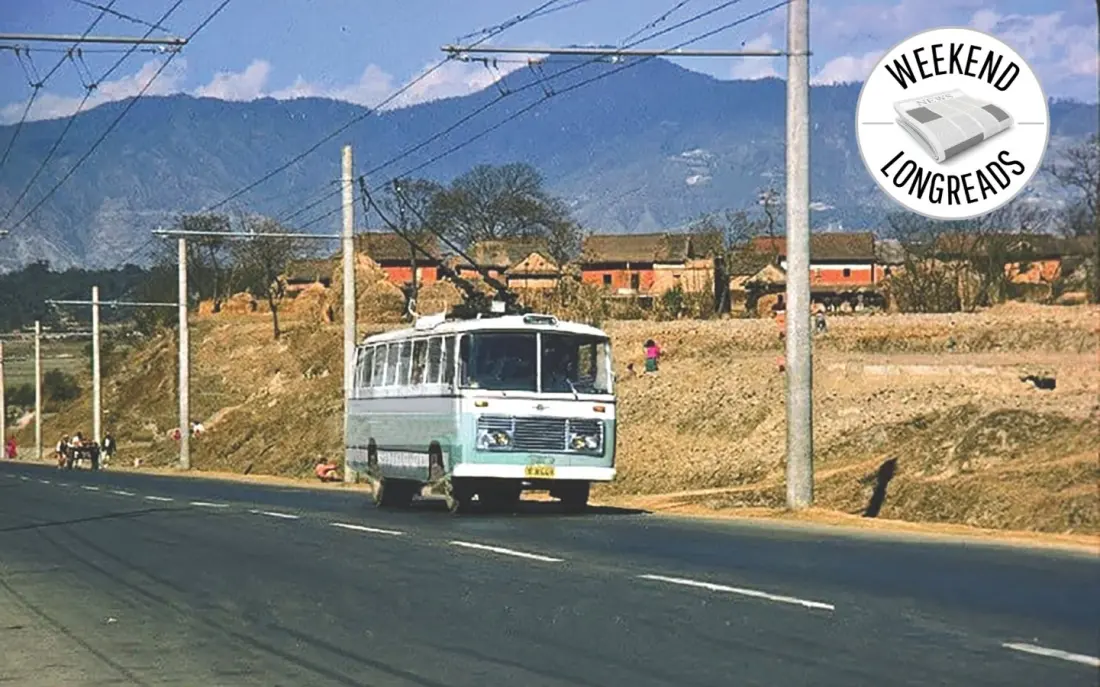
Long before electric buses became a climate buzzword, Kathmandu had a working trolley bus network powered by Nepali hydroelectricity. It opened in December 1975 and closed for good within a generation.
The story begins with roads: the Chinese built the Arniko Highway from Bhaktapur to the Tibet border in 1964, and by 1973 had agreed to electrify the 13km corridor between Kathmandu and Bhaktapur. The buses themselves were Shanghai-built SK-541 models from 1974 — 26 seats, standing room for 35, an 80 HP motor and a top speed of 50km/h. Prime Minister Tulsi Giri launched the service on 28 December 1975, King Birendra's birthday, and at its peak 22 buses carried up to 12,000 passengers a day along the route to Suryabinayak.
The numbers never added up, though. A 1982 dissertation by graduate student Arjun Raj Banshi documented losses every single year, with salaries eating over half of expenditure and power a further quarter. Riders hopped off without tickets, conductors looked the other way, and trained technicians left for better-paid work. Worse, the electricity supply itself was unreliable — buses regularly sat stranded for hours during blackouts. The economics worsened over time: by the 1990s a trolley bus round trip cost Rs125 in electricity against Rs70 of diesel for a conventional bus, while new overhead wiring ran to Rs8 million per kilometre.
Ambition, however, kept flowing. Feasibility studies and five-year plans repeatedly promised extensions — to Ring Road, Kirtipur, Patan, and even long-distance Tarai routes from the Indian border towns of Jogbani and Sunauli to Dharan and Butwal. A 1977 study projected Rs14.7 million in profits on a Rs400 million investment for an electrified Tribhuvan Rajpath. None of it was built.
China briefly resuscitated the fleet with ten new buses in 1996, each costing $79,000, but by then only 13 of the original 22 were even running, spare parts had dried up, and unpaid electricity bills topped Rs3 million. The last trolley bus left Bhaktapur on 19 December 2001. A brief comeback in 2003 fizzled, and in March 2007 the government ripped up all 278 poles to widen the Arniko Highway — dumping them at Sallaghari, where they sat for over a decade.
Why should a traveller care? Because it reframes Kathmandu's infamous traffic and air pollution. The city's congestion isn't simply a lack of development — it's the collapse of a system that once worked. A 1999 consultants' study estimated that just 48 trolley buses on two routes would have cut diesel imports by Rs176 million a year. Today's visitors will find no trace of the line, but the route it served — Kathmandu to Bhaktapur — remains one of the valley's most rewarding short trips, past Thimi's pottery squares to Bhaktapur's remarkably preserved medieval old town.
The tale is a sobering case study in how good infrastructure dies without management, funding and political follow-through — and a reminder that Nepal's transport problems are older, and more solvable, than they look.
Story via Nepali Times.