A painted lady butterfly drifting over a thistle on a French chalk hillside is a fitting mascot for one of the more intriguing geotourism projects in Europe. The insect makes an epic annual migration between North Africa and the Arctic along much the same corridor as Dover–Calais ferry passengers — and it takes roughly six generations to complete the 9,000-mile round trip. Humans, it turns out, are borrowing the same idea: two countries, one shared story.
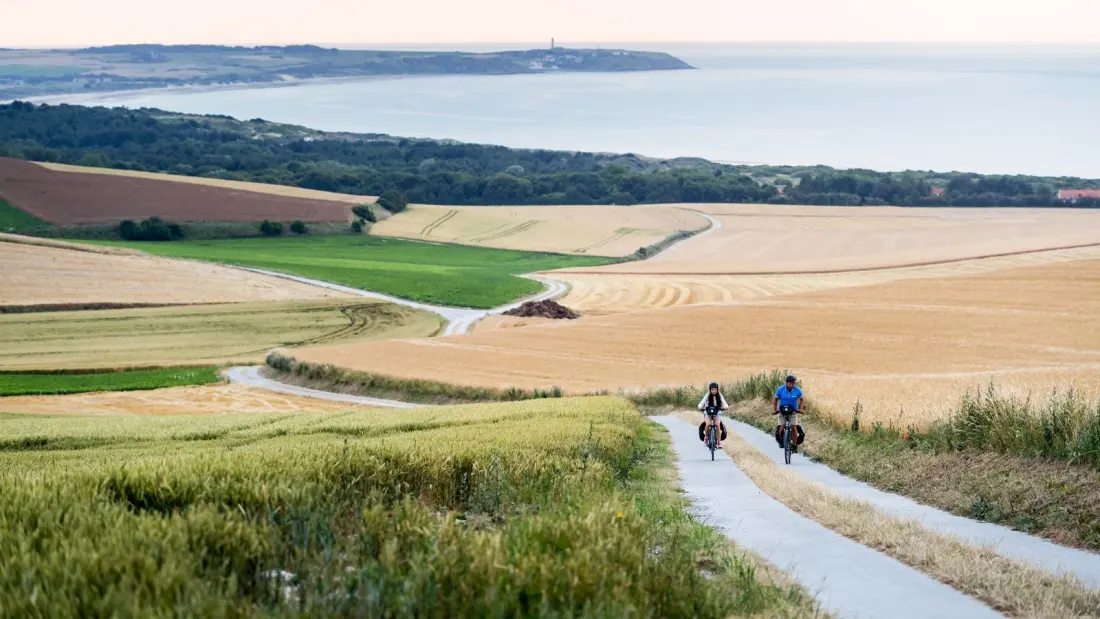
The Cross Channel–Transmanche Geopark links 43 designated Geosites spread across two protected areas: the Kent Downs National Landscape in southeast England and the Caps et Marais d'Opale Regional Nature Park on France's north coast. Among them are places like the soft, rolling chalk downlands of Mont Hulin and Mont Pelé in the Cuesta du Boulonnais, a 62-hectare (153-acre) protected zone southeast of Boulogne. The shared geology makes sense of the pairing: the chalk that defines the Kent Downs doesn't stop at the water's edge — it resurfaces on the French side as the same seams of rock split by the Channel.
What's new is the ambition. French and English experts have collaborated for more than two decades on research, conservation and tourism promotion. This year they formalised a joint bid for UNESCO Global Geopark status, which would make it the world's first Geopark spanning two countries separated by a sea. The designation recognises areas of significant scientific geological interest and typically brings funding, international visibility and a boost to low-impact rural tourism.
For travellers, the appeal is already there whether or not UNESCO signs off. On the English side, the Kent Downs offer white-cliff walks, ancient woodland and villages within easy reach of London. Across the water, the Boulonnais hills and the Opale coast deliver a quieter counterpart: grassy ridgelines with butterfly-rich meadows, dunes, marshes and coastal capes around Boulogne. A crossing of roughly 90 minutes by ferry or a hop through the Channel Tunnel means you can realistically walk chalk grassland in Kent in the morning and stand on Mont Pelé by afternoon — a two-country itinerary stitched together by shared rock.
Conservation groups such as Eden 62, which guides visitors through the French sites, are part of what makes the area worth the trip. Guides point out not just geology but the wildlife that depends on it, from migrating painted ladies to the plants of the chalk meadows. The bid itself signals more investment in trails, interpretation and cross-border routes over the next few years.
This one is for walkers, geology enthusiasts and anyone who fancies the novelty of a holiday that officially spans a sea. If the bid succeeds, expect the Cross Channel–Transmanche Geopark to become a name worth knowing.