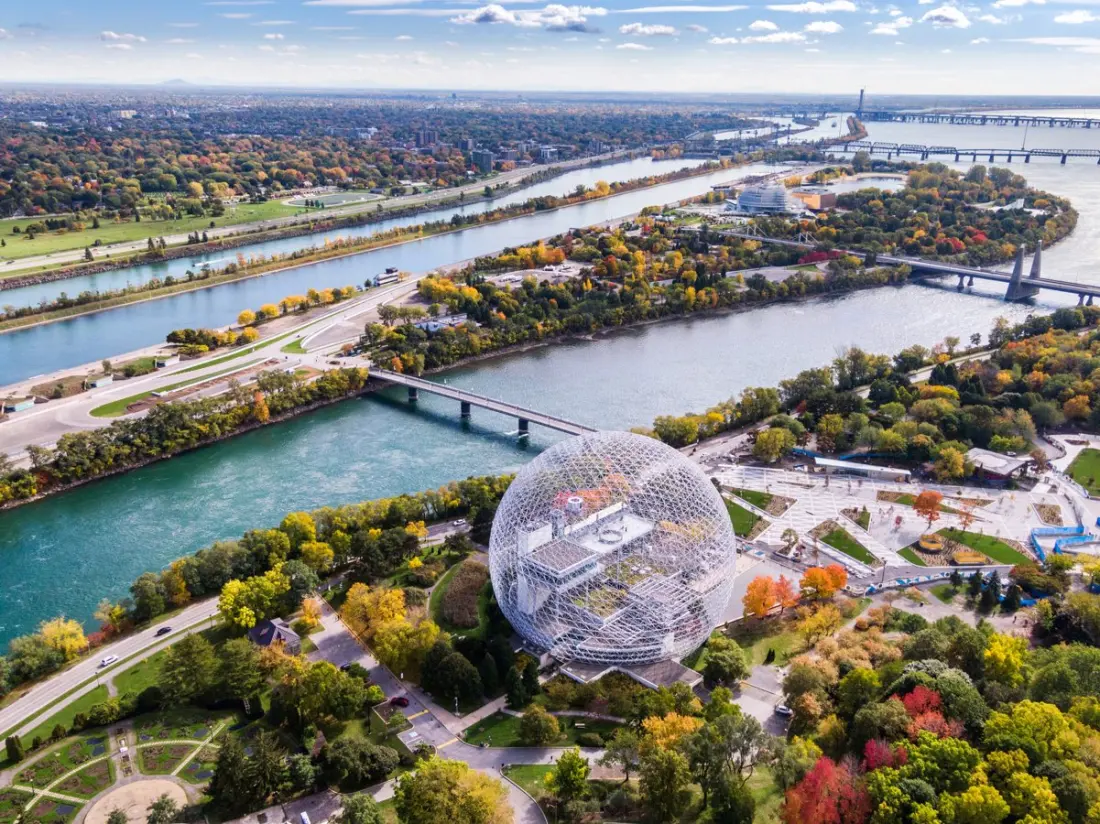
A giant silver sphere sitting on an island in the St. Lawrence River looks like it landed from another planet — and in a way, it did. The Montreal Biosphere began life as the American pavilion at Expo 67, the World's Fair that drew millions of visitors to Montreal in the summer of 1967. Architect R. Buckminster Fuller, working with Shoji Sadao, designed its geodesic dome as a futuristic shell containing a NASA moon-themed exhibit alongside displays of American folk art, music and contemporary painting.
The dome's story after the fair is a bumpy one. In 1968 it was renamed the Biosphere and turned into an aviary filled with birds and hanging plants, plus exhibits on pollution and humanity's impact on the environment — an unusually forward-looking theme for the era. Then in 1976 a fire melted the entire acrylic outer skin, leaving the bare steel lattice standing empty for two decades. The structure finally found its calling in 1996, when a museum devoted to the St. Lawrence River opened on its main floor.
Today the Biosphere is an environment-focused museum exploring the tension between the natural world and industrial society — a fitting message inside a building that has itself survived fire and reinvention. The spherical form and delicate web of steel are striking from every angle, and after dark the dome is illuminated in bright multi-coloured lights for an almost psychedelic effect.
You'll find it in Parc Jean-Drapeau, a pair of small islands just outside downtown Montreal. Admission was set at C$25.50 for adults in 2026, with discounts for seniors, students, children, families and Montreal-area residents; kids under four go free. Plan on one to two hours inside, longer if you wander the park. Interactive exhibits aside, one of the best perks is the lookout points, which deliver wide views over Montreal's skyline and the river — especially rewarding on a clear late-afternoon visit that stretches into night, when the light show kicks in.
Getting there is simple: take the Metro to Jean-Drapeau station and walk a few minutes, or drive and park in the nearby paid lots (P10 and P11 are closest). Warm-season hours generally run 9 a.m. to 6 p.m. daily, though schedules can shift and some Mondays close later in the year, so check ahead.
Montreal is famous for its old-world French character — cobblestones, churches, poutine — but the Biosphere represents the city's other side: the bold, future-obsessed spirit that wowed the world in 1967. Architecture fans may find the exterior alone worth the trip across the river, and anyone visiting between May and October can easily pair it with a picnic and bike ride around Parc Jean-Drapeau. It's a quick, affordable stop that doubles as one of the city's most photogenic landmarks.