Some of the most fascinating bits of highway history aren't on any current map. Around the world, once-busy roads have been left to crumble under vegetation, and a growing number of them have become genuine travel attractions — some officially restored, others still wild and unofficial.
The most accessible is arguably the fresh reopening of a quarter-mile stretch of original Route 66 near Springfield, Illinois. This Carpenter Park section carried drivers between 1926 and 1936 before the highway was rerouted, and trees had nearly swallowed it. Preservationists stepped in, and in 2025 local officials held a ribbon-cutting to reopen it to the public for the first time since the 1930s, complete with photo spots and 1930s-style advertising displays.
In Pennsylvania, the abandoned Turnpike is a cult favourite. Opened in 1940, the turnpike drew 2.4 million cars in its first year — nearly double projections — so in 1968 authorities bypassed 13 miles of the original route. Today that stretch, with its graffiti-covered tunnels, has a post-apocalyptic atmosphere. It famously appeared in the film The Road, and cyclists tackle it via the Pike 2 Bike trail. It's not an official attraction, so bring a flashlight, reflective gear, and the understanding that you're there at your own risk.
California has two notable relics. The Ridge Route, opened in 1915 as the first direct mountain link between Los Angeles and the Central Valley, was so dangerous — 31 deaths between 1921 and 1928 — that a safer alternate opened in 1933. Sections of old pavement, including the infamous Dead Man's Curve and the ruins of a motorist stop called the Tumble Inn, remain visible to hikers and to drivers on Interstate 5. Far south, the Old Plank Road once helped early motorists cross the Imperial Sand Dunes.
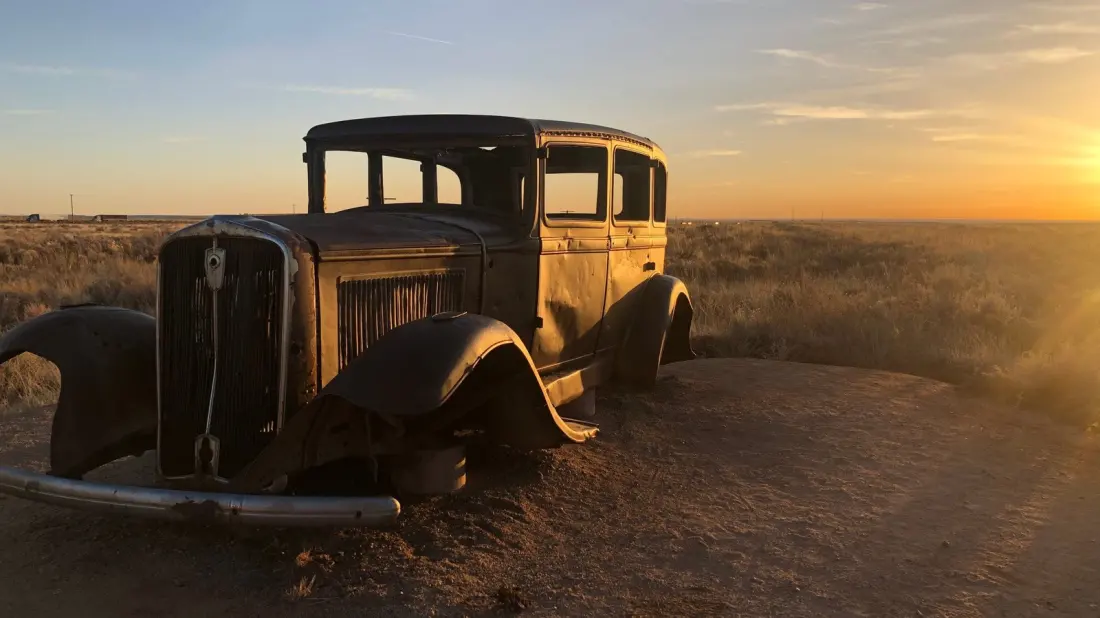
Arizona's Petrified Forest National Park hides traces of two historic roads: East Old 180, rerouted partly to protect petrified wood from souvenir-hunters, and old Route 66, marked by a rusted 1932 Studebaker. Nearby, the former Lion Farm tourist stop once kept actual mountain lions in captivity.
For something more remote, Hawaii's Old Pali Road on Oahu crosses the Ko'Olau mountains — workers unearthed more than 800 skulls there, belonging to warriors driven off cliffs at the 1795 Battle of Nu'uanu. You can view remnants from the Nu'uanu Pali Lookout or hike stretches of it; the wind is famously strong enough to feel like it's pushing you uphill.
The most demanding of the lot is Canada's Canol Heritage Trail in the Northwest Territories: a 231-mile abandoned section of a WWII-era road and pipeline project that ran more than $100 million over budget and was abandoned in 1945, a year after completion. Hiking it takes two to three weeks and demands serious prep — pack rafts for river crossings, pre-arranged food drops, a satellite phone and bear spray. Drivers can still tackle drivable sections, including the North Canol Road's graveyard of abandoned military vehicles.
Why bother? These sites let you touch the history of how people moved — and they photograph like nothing else. Just treat the unofficial ones with care.