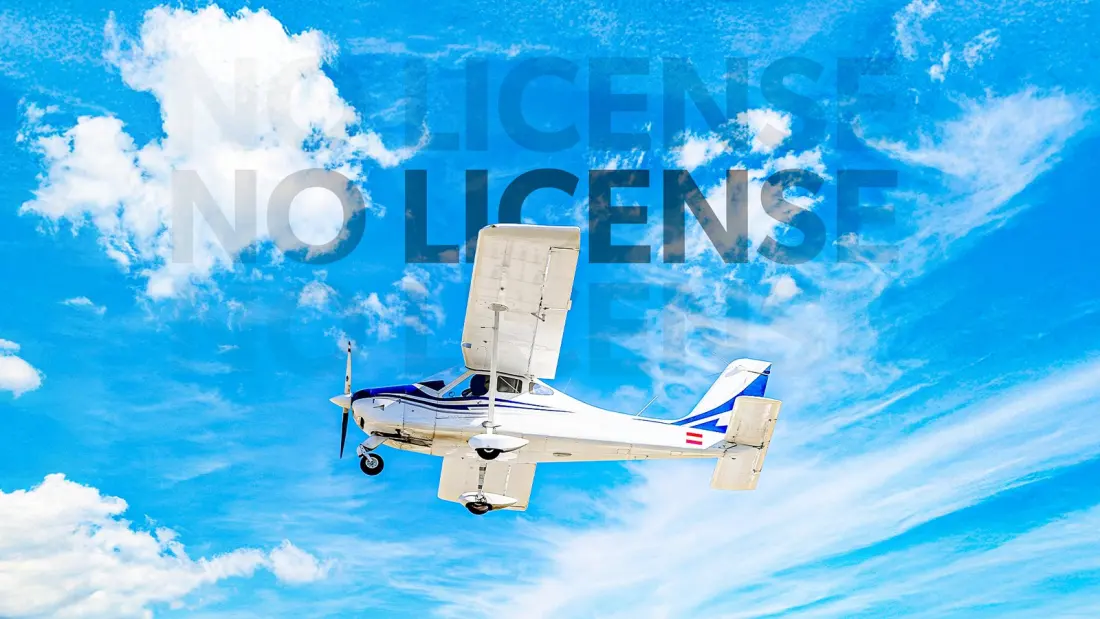
In the United States, you can legally take to the skies without a pilot's license, medical certificate, or any aircraft registration at all — as long as you fly an ultralight. It's thanks to FAA rules called Part 103, drafted back in 1982, which rest on a simple idea: an aircraft light and slow enough poses minimal danger to people on the ground, so it barely needs regulating. The US is essentially alone in this — Canada, the UK, Australia, New Zealand and European countries all require at least basic training and registration.
The catch is that the vehicle must meet tight specs. A powered ultralight must be single-seat, weigh under 254 lb (115 kg) empty, carry no more than five gallons of fuel, and top out at 55 knots with a 24-knot stall speed. Unpowered craft like hang gliders and balloons get a 155 lb (70 kg) ceiling. Flights are daylight-only, must stay out of congested areas and most controlled airspace without prior authorization, and the FAA insists the flying is strictly recreational — no commercial use, and safety is your own responsibility. The FAA also notes no training is legally required, though it strongly recommends getting instruction before you fly.
Qualifying machines fall into four broad types. Powered paragliders (paramotors) are the lightest and most portable — essentially a backpack motor of around 46–65 lb paired with a fabric wing. Powered parachutes pair a wheeled cart and small engine with a big square canopy, flying slowly and stably. Weight-shift trikes hang a hang-glider-style wing over a three-wheeled carriage steered by shifting your body. Fixed-wing ultralights look like miniature conventional airplanes, with proper ailerons, elevator and rudder.
If the idea appeals, entry costs are surprisingly low. Second-hand ultralights sell for a few thousand dollars, while new ones can run to tens of thousands. You'll find them via specialist dealers and marketplaces like Barnstormers, Hangar67 and PilotMix. One notable option is the U-Fly-It Aerolite 103, a fixed-wing kit whose airframe kit sells for $19,450 — the company says a first-time builder can assemble it in roughly 30–40 hours. A word of caution: some aircraft are marketed as ultralights when they don't actually meet Part 103 limits, so check the specs before buying.
If you eventually want more, the next rung up is the Sport Pilot Certificate, created in 2004 and dramatically expanded by the FAA's MOSAIC rule that took effect in October 2025. Sport pilot training requires just 20 hours — half the private pilot minimum — and under MOSAIC you can now fly aircraft with up to four seats, with no weight cap, after appropriate training and endorsements.
Why does this matter to travellers? For anyone who has dreamed of flying but been priced out of conventional aviation, ultralighting is one of the cheapest, lowest-barrier ways to actually do it — a paramotor or trike holiday can be planned around scenic flying spots across the US, no license paperwork required. Just remember Part 103 applies only to US airspace; rules abroad differ and almost everywhere else you'll need some form of license or registration.