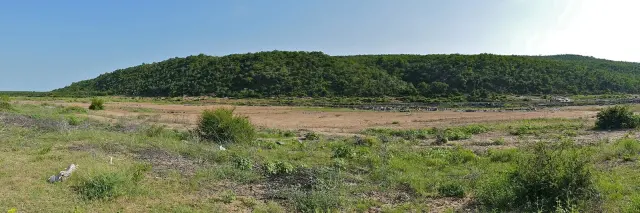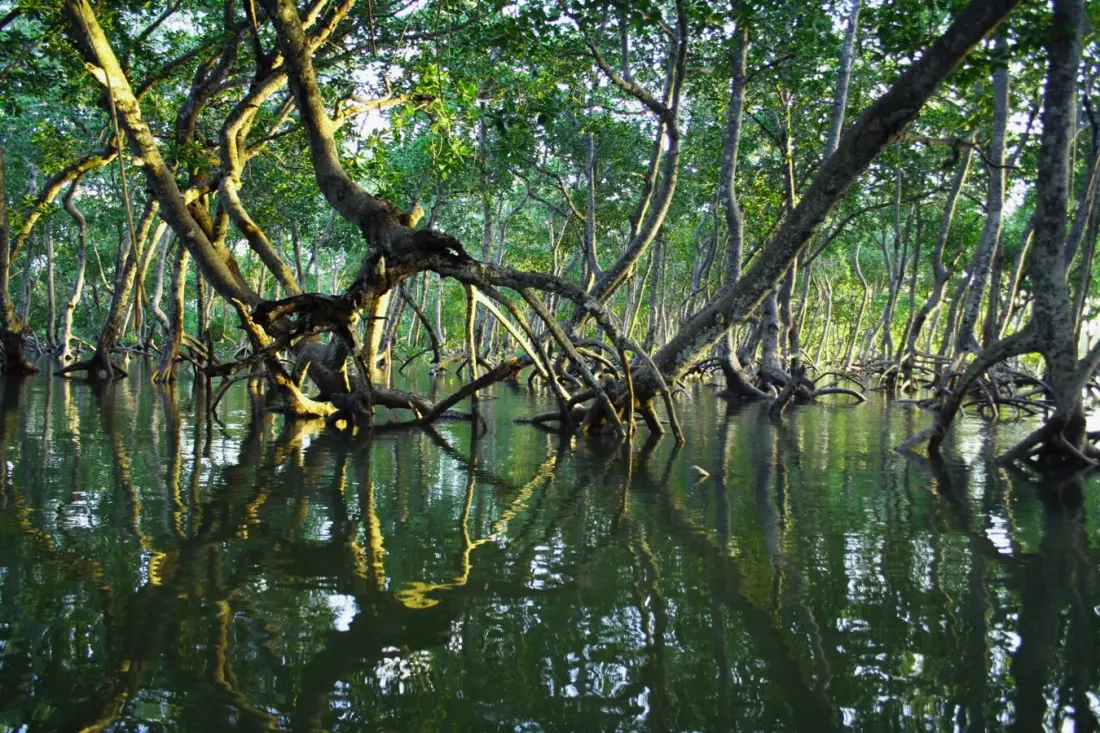
South Africa's third-largest mangrove forest sits quietly about 20km south of Port St Johns, where the Mngazana River meets the Indian Ocean. Around 146 hectares of tangled roots and tidal channels make this one of the most unusual places to explore on the Wild Coast — best done by kayak or canoe, at a slow pace, with a local guide.
The forest is home to three mangrove species, each easy to tell apart once you know what to look for: white mangroves with pencil-like roots poking out of the mud, red mangroves on arching stilt roots, and black mangroves with distinctive knee-shaped roots. All three have evolved these odd structures to cope with salty, oxygen-poor sediment. Mngazana also sits close to the southern edge of mangrove distribution in Africa, which makes it ecologically significant beyond its size.
There's plenty of life hidden among the roots. The channels act as a nursery for fish, with research recording a mix of tropical, subtropical and temperate species in the estuary. Crabs shelter in the mud, and birdlife gathers along the banks — birdwatching from a quiet kayak is one of the best reasons to visit. The forest also does unglamorous but vital work: trapping sediment, limiting erosion and storing carbon.
The mangroves are woven into local life, too. Villages around the estuary have long used the forest for firewood, building materials and fishing bait. A nice example of a gentler model is the Sise Cwebeni Bee Farming Cooperative, started in 2010 by eight villagers, who keep hives deep in the forest and harvest honey — a livelihood that earns income without stripping the resource. A fire destroyed their processing facility in 2020, but members have kept going on a smaller scale.
For travellers, the practical route in is via Mngazana Adventures, a family-run operator in Madakeni village offering guided mangrove tours, kayaking trips and birdwatching. A local guide adds context on the wildlife and the communities who have lived beside the estuary for generations.
Worth knowing: the forest faces real pressure. A 2026 study across 17 Eastern Cape estuaries flagged wood harvesting, livestock trampling and browsing as threats, and researchers noted harvesting pressure on Mngazana's red and black mangroves. Conservation efforts through the Eastern Cape Parks and Tourism Agency are working to strengthen protection along the Wild Coast, with community livelihoods part of the picture.
If your image of the Wild Coast is dramatic cliffs and empty beaches, Mngazana offers something quieter — a water-level view of an ecosystem most visitors drive right past.
Story via Getaway South Africa