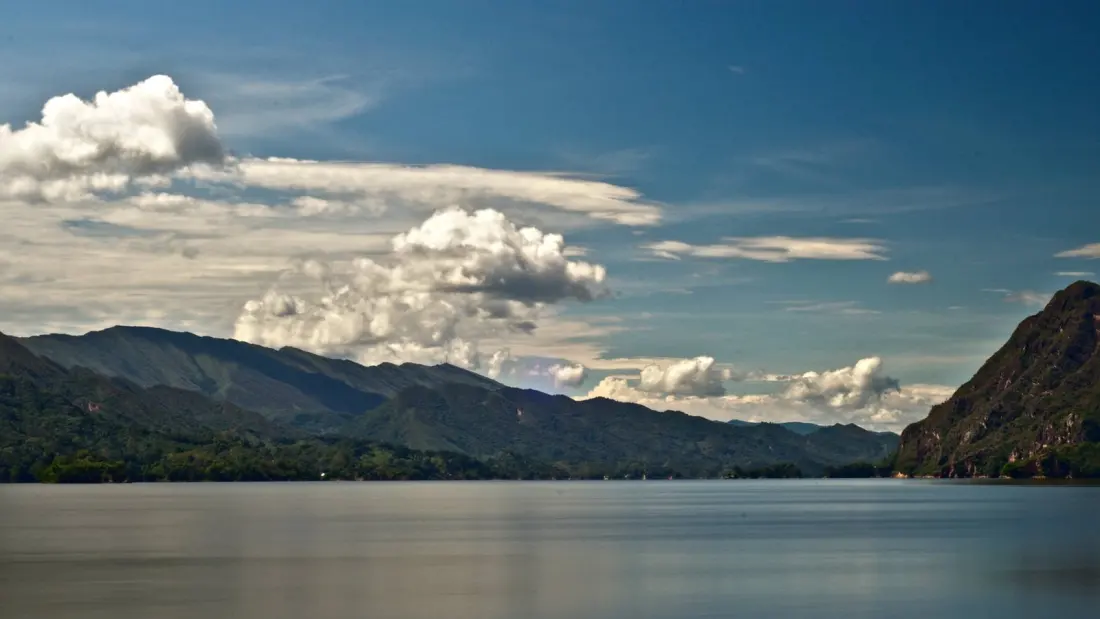
Three hours' drive southwest of Bogotá, a stretch of open water framed by green mountains has earned itself a bold nickname: Colombia's inland sea. The Darío Echandía reservoir at Prado, in the department of Tolima, covers roughly 4,200 hectares, runs about 28 kilometres from south to north and plunges to 90 metres at its deepest point. It's big enough that boats are the main way of getting around.
The lake wasn't built for tourists. Construction on the dam started between 1959 and 1961, with German and Japanese firms directing the project and Colombian workers doing much of the building. The hydroelectric plant came online in 1972, still runs at around 51 megawatts, and now supplies power to parts of Tolima and Huila plus the town of Girardot under the management of Celsia. The Cunday and Negro rivers feed the reservoir, which sits within the Magdalena basin. Fishing for tilapia remains part of the local economy, and tourism only grew up around it once people realised the scale and scenery were worth a weekend.
Most trips start at the pier, where boats set off for attractions dotted around the shoreline. Highlights include the Laguna Encantada, a pool hemmed in by tall rock walls that legend says never changes water level, and the Laberintos de Yacupi, a set of rock passages carved along a geological fault that doubles as a birdwatching spot. There's also the Cueva del Mohán, a small cave with a narrow opening that lets light and water in, and the Cañón de los Enamorados. The Cascada del Amor is a 12-metre waterfall reachable only by boat, with a swimmable pool at its base. The largest island in the reservoir, the C-shaped Isla del Sol, has around 200 residents.
For anyone who'd rather be on or in the water than looking at it, options run from wakeboarding, water-skiing and jet skis to canoeing, paddleboarding and plain swimming. Accommodation ranges from cabins and condominiums to campsites right by the shore.
Prado sits about two hours from Ibagué, making it a feasible long weekend trip. From Bogotá, drivers head south through Soacha and follow National Route 40 past Girardot, Espinal and Saldaña before the signed turn-off to Prado; the last stretch takes 30 to 40 minutes and ends at the pier. No car? Direct buses make the journey in around six hours.
It's a good pick for travellers who've done the Colombian classics — Cartagena, the coffee axis, Medellín — and want something inland and low-key with a genuinely unusual landscape: warm-water recreation in the middle of the Andes, minus the crowds.