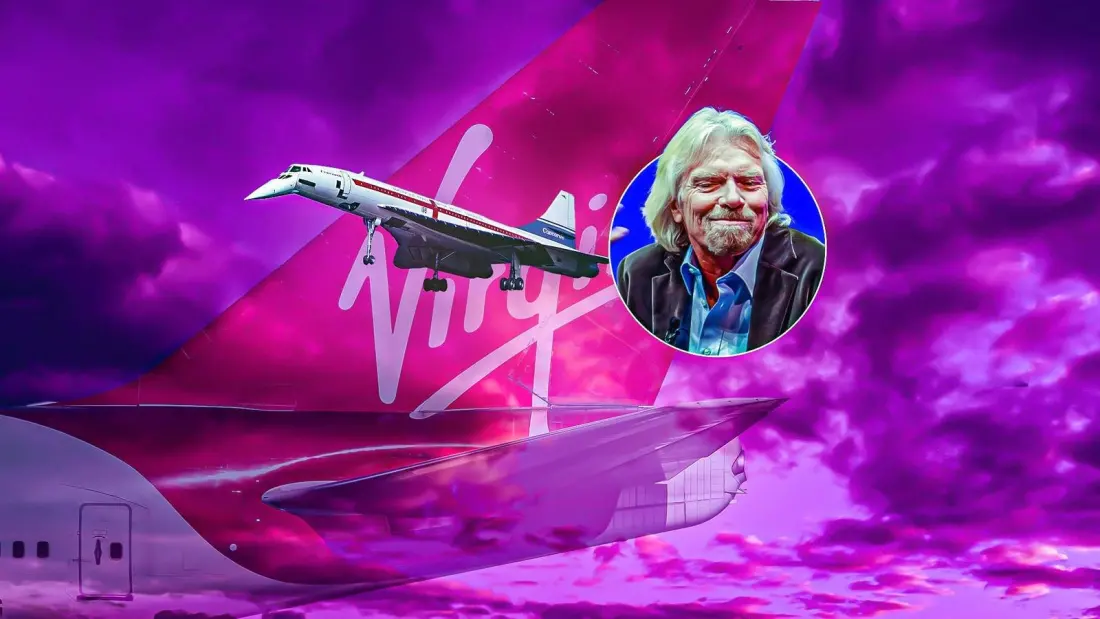
When Concorde made its last flight from Heathrow to Bristol in November 2003, supersonic passenger travel died with it — or so most people thought. Richard Branson spent the next two decades trying to prove otherwise, first by trying to buy the retired jets and later by backing a startup building a successor.
His boldest attempt came the day after British Airways and Air France announced the retirements in April 2003. Branson offered £1 per Concorde — the same symbolic price BA had paid — then escalated to £1 million and eventually £5 million per aircraft. Virgin planned to fly the five most airworthy jets to Dubai, Washington, New York and Barbados, and even floated a charitable heritage trust to keep two flying. BA refused, Virgin called the decision 'industrial vandalism,' and Branson's appeal to the UK government went nowhere: Trade Secretary Patricia Hewitt found no trace of the clause in the BA privatisation deal he cited, and Airbus declined to support the fleet beyond retirement.
The jets themselves had become impossible to run profitably. Numbers had dropped sharply after the July 2000 Air France crash in Paris, which killed 109 passengers and crew plus four people on the ground, and the post-9/11 travel slump finished the job. Add fuel burn of roughly 6,771 gallons per flight and growing noise complaints, and retirement was inevitable. Only 20 Concordes were ever built against early forecasts of 350.
Undeterred, Branson turned to Denver startup Boom Supersonic in 2016. Through Virgin Galactic, he took options on Boom's first 10 airframes and backed a jet designed to cross the Atlantic in 3.5 hours at around Mach 1.7, targeting fares near $5,000 return — roughly business class money. But the deal quietly expired in August 2020 by mutual consent, and the London-New York flights never happened. Boom now presses on alone with its Overture aircraft, targeting entry to service around 2030, while Virgin says it still monitors high-speed, sustainable air travel. The surviving Concordes, meanwhile, have now been grounded for over 20 years and will almost certainly never fly again.
For travellers, this story is equal parts nostalgia and a glimpse of what might return. If Boom or its rivals succeed, a London-New York hop under four hours could be back on the menu — at a premium price, but no longer the sole preserve of a single iconic jet.