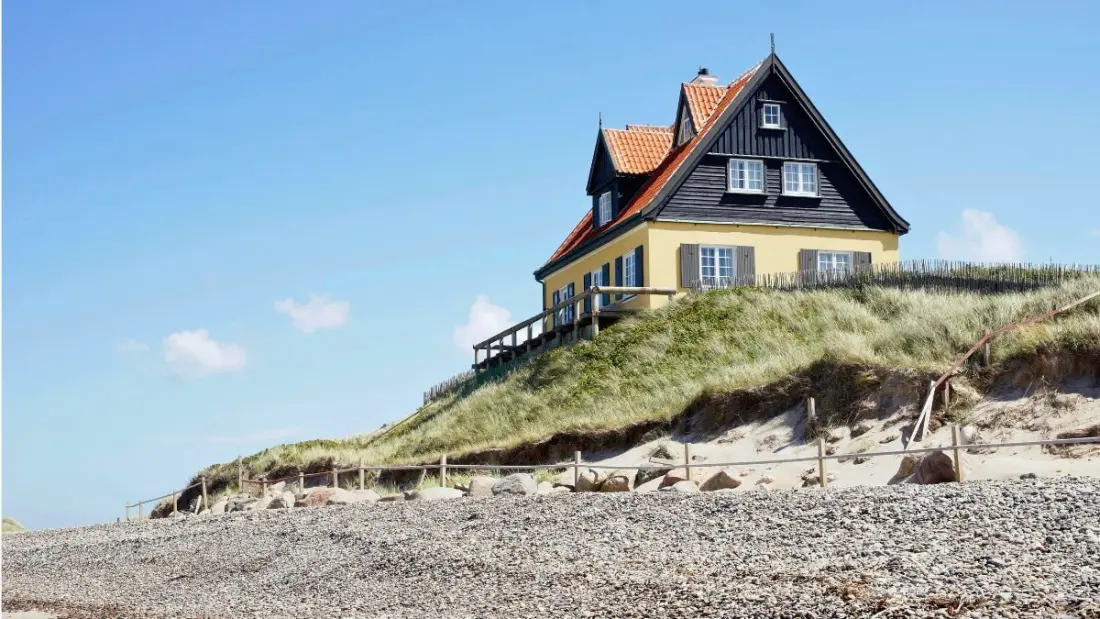
At the very top of Jutland sits Skagen, Denmark's northernmost town and one of its most popular summer escapes. It's a place of mustard-yellow houses with white-trimmed red roofs, a working fishing harbour, and a famous sand spit where the Skagerrak and Kattegat visibly collide. Writer David Nikel from Life in Norway has visited twice this year — once in miserable rain, once in glorious sunshine — and the difference was striking. On a warm day, the streets fill with bicycles, restaurant terraces spill towards the harbour, and the yellow buildings glow under a very blue sky.
The star attraction is Grenen, the shifting sand point at the tip of the country where waves roll in from two directions. You can walk there along the beach from the car park, or ride the tractor-pulled carriages of the Sandormen if you'd rather save your legs. One warning: swimming is banned around the tip, as the currents are genuinely dangerous. The spit itself keeps growing, reshaped constantly by sand and gravel carried along the coast.
Skagen's cultural story is just as compelling. From the 1870s, artists including P.S. Krøyer, Michael and Anna Ancher, Holger Drachmann and Laurits Tuxen came for the extraordinary coastal light and long summer twilights, painting fishermen, beaches and everyday life instead of formal studio subjects. Skagens Museum, near the town centre, holds a major collection and even preserves the dining room of Brøndums Hotel, the painters' social hub. A short walk away, Anchers Hus keeps Anna and Michael Ancher's home much as they left it — worth seeing after the museum, when the paintings start to feel real.
Even the town's famous yellow is more practical than pretty: limewash protected brick from harsh coastal weather, and the white roof lines originally covered the mortar used to secure tiles against the wind. Weatherproofing became a signature.
Beyond town, the landscape tells its own story. The Sand-Buried Church, abandoned in 1795 after drifting sand made it unusable, now survives only as a lone white tower in the dunes. Farther south, Råbjerg Mile is a migrating dune covering roughly a square kilometre that creeps 15 metres northeast every year — walking it feels closer to a mini desert than northern Europe.
Skagen works as a day trip — centre, harbour and museum combine easily — but an overnight stay lets you add the church and the dune, and enjoy the town once the day-trippers leave. Whenever you go, pack an extra layer; the sea is never far away.