Two ancient rock-art sites near Moab, Utah, are the latest victims of a growing problem on America's public lands. On November 6, the Bureau of Land Management confirmed it was investigating after someone carved names into petroglyphs at two separate locations — and officials warn some of the damage may never come out.
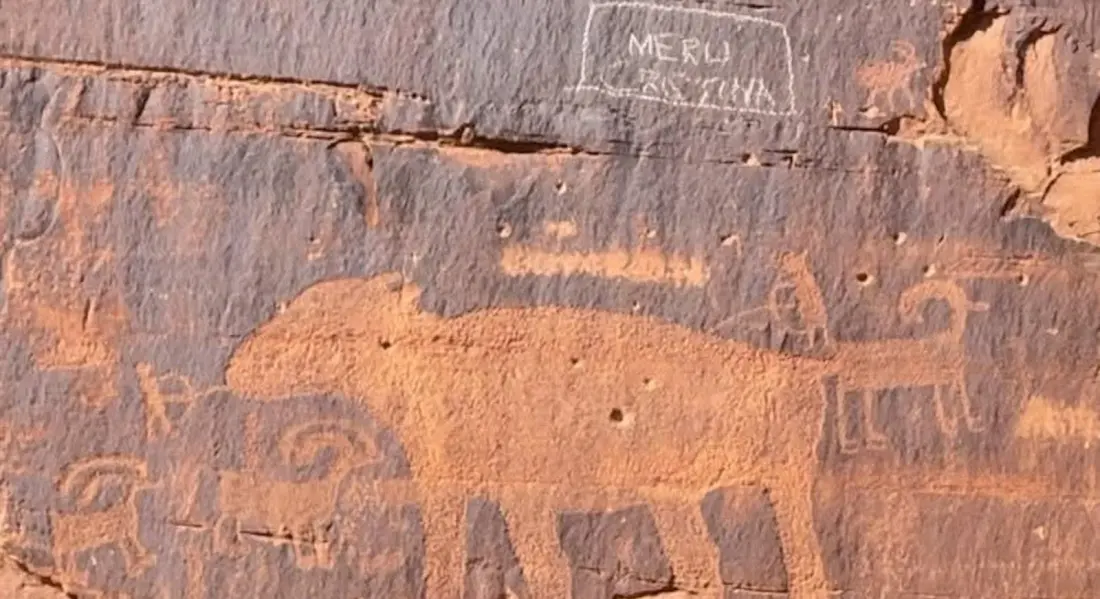
The first site is the Bear Panel along Highway 279 near the Colorado River, where the name "Meru" was scratched above carvings of a bear and a bighorn sheep. The second, near Hell's Revenge — a well-known four-wheel-drive trail in Sand Flats Recreation Area — had "Craig W" gouged across several figures. Most of the artwork dates back around 1,500 years and comes from Ancestral Puebloan and Fremont traditions, plus more recent Indigenous communities. Some panels are thought to be as much as 2,000 years old.
Restoration is tricky for reasons you might not expect. At Hell's Revenge, the graffiti sits directly on top of the original carvings, so scrubbing the stone or painting over the marks could destroy the art underneath. At the Bear Panel, there's a crack in the sandstone below the graffiti — scraping the rock could let rainwater in, and Utah's freeze-thaw cycles would slowly break the panel apart. Utah's state historic preservation officer Chris Merritt summed it up bluntly: five minutes of damage can take weeks of careful repair, and any work has to involve consultation with descendant tribal communities.
There's a legal sting, too. Under the federal Archaeological Resources Protection Act, defacing protected archaeological sites can bring fines up to $20,000 and two years in prison. That's not a theoretical threat — in November 2025, a Utah woman who vandalised petroglyphs near Wire Pass got 12 months' probation, a $14,853 bill in fines and restitution, and a ban from BLM land while on probation.
What worries preservationists most is the trend. Merritt says that while people have been scrawling initials on rock panels since the 1800s, the last five or six years have seen a sharp jump in both scale and spread, hitting panels that were previously untouched. He links it to rising visitation across Utah's public lands. A similar case was investigated near Tusher Tunnel in March 2026. The state is responding with its Protect Our Past education campaign, a volunteer network of site stewards, and signage and fencing at vulnerable panels. Anyone with information on the Moab cases can call Moab BLM Law Enforcement at 435-259-2131.
For travellers, the takeaway is simple: Moab's rock art is some of the most accessible ancient art in North America — you can walk right up to it along highway pullouts and trailheads — and that access depends entirely on people treating it as irreplaceable, not a guestbook. Touch nothing, keep dogs and kids from rubbing against panels, and report damage if you spot it. These sites have survived two millennia; they need visitors to keep them intact for the next one.
Original reporting by Backpacker.