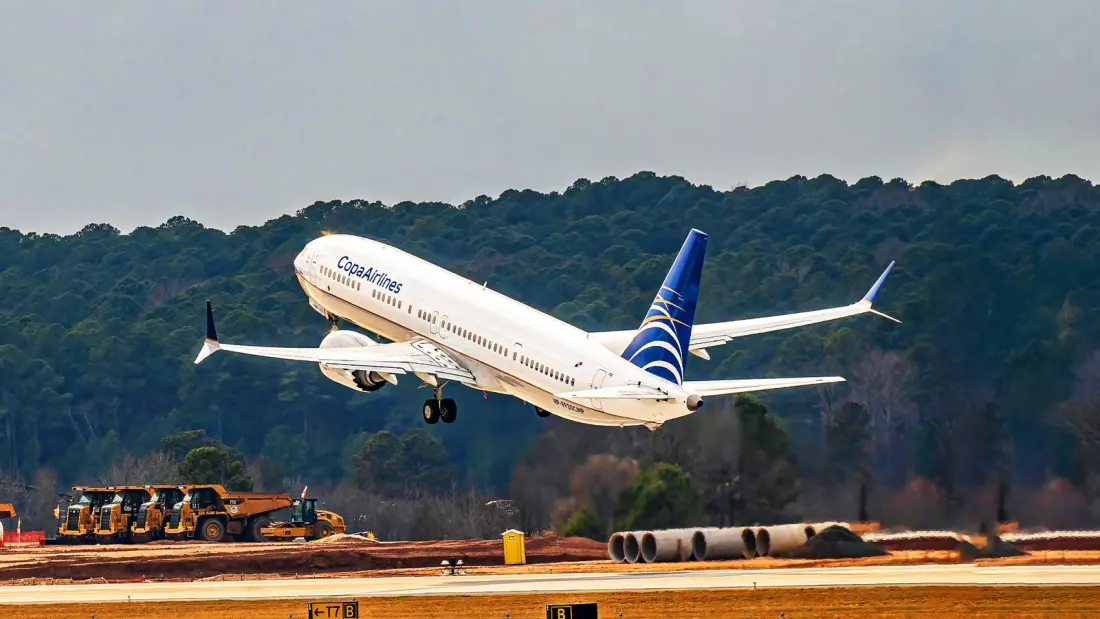
If you've watched planes at Panama City's Tocumen Airport, you may have spotted the resemblance: Copa Airlines jets wear a white body, blue belly and a globe on the tail that looks a lot like the pre-2019 United Airlines look. That's no accident — and it's also why Copa never followed United into its newer Sky Blue scheme.
The design dates to 1999, when Houston-based Continental Airlines held a 49% stake in Copa through the newly formed holding company Copa Holdings. The two carriers codeshared closely, shared the OnePass loyalty programme, and wanted their branding to shout about the partnership. Copa drew up a livery that mirrored Continental's almost exactly, differing only in the globe design and typeface. It has barely changed since — the airline is still flying that look nearly three decades later.
Continental's ownership didn't last. Its stake fell to 27.3% in 2005, then 10%, and was fully divested by 2008. When Continental merged with United in 2010, the partnership with Copa carried on — both joined Star Alliance (Copa in 2012), and Copa used OnePass and then MileagePlus before launching its own ConnectMiles programme in 2015. But crucially, United holds no equity in Copa, and the two companies market themselves entirely separately. When United rebranded in 2019, it didn't consult Copa, and Copa has no plans to follow suit. Its next livery may well have no Continental or United DNA at all.
Why keep a 27-year-old design? Because it still works. A livery is an airline's brand made physical, and rebrands are risky when your reputation is strong. United itself is the cautionary tale: after a rocky decade of merger turmoil and poor public perception, its 2019 Sky Blue refresh was part of a deliberate attempt to reset the brand alongside premium products like Polaris. Back in 2010, the merged carrier had even kept Continental's globe and livery with the United name, because Continental's reputation at home was stronger — a bit of brand surgery travellers rarely notice.
For flyers, the practical upshot is that Copa remains one of Latin America's most reliable airlines: over 100 Boeing 737s (119 in total, from the -700 to the MAX 9) serving roughly 90 destinations from a hub it calls the Hub of the Americas. Because nearly every major city in the Americas is within narrowbody range of Panama City, Copa's costs are low and its connections between North and South America are hard to beat — often cheaper via Panama than via a US gateway. It serves 17 US destinations, and United feeds it from Houston and Newark with three daily 737 MAX 9 rotations, while American still leads the overall US–Latin America market.
So if you're booking a trip through Panama, you're flying with an airline that built its look as Continental's junior partner but has long since outgrown the template — and sees no reason to repaint the planes.