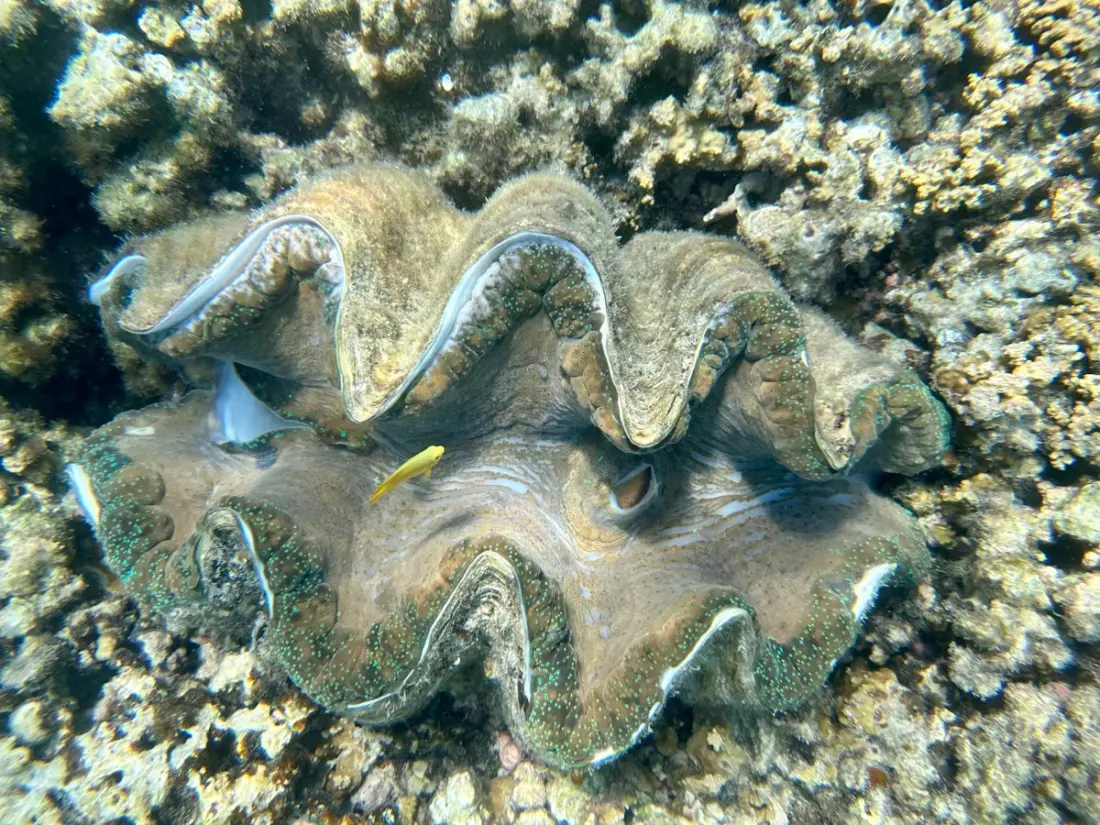
A single shell has handed scientists something they rarely get: a season-by-season record of the Great Barrier Reef from before anyone was measuring the ocean. The shell belonged to a Tridacna gigas — the world's largest living bivalve — that spent roughly three decades anchored near Jiigurru, the Lizard Island Group in the northern reef, between about 1785 and 1827.
The trick is in how the animal grew. Giant clams add microscopic layers to their shells daily, and researchers counted close to 10,900 of these growth lines on the 58cm specimen. Read the chemistry locked inside each layer and you get a rolling record of sea temperature and rainfall across the clam's lifetime, year by year, season by season.
The headline finding: the waters around Jiigurru were measurably cooler than they are now. Reconstructed temperatures came out 0.6°C to 0.9°C below modern averages, with summers up to 1.2°C cooler. The shell even caught shifts in rainfall and patterns that look like El Niño and La Niña events — all from a stretch of time when there were virtually no direct climate measurements in the tropical Southern Hemisphere.
That's what makes this more than a curiosity. Natural archives like corals, ice cores and shells are the only way to push past the limits of instrument records, and giant clam shells are unusually good at it, capturing environmental detail at remarkably fine timescales. Researchers think other specimens could help build a much broader picture of how the Indo-Pacific climate has shifted over centuries. One clam doesn't explain the whole reef, but it's a solid piece of the puzzle — and a useful benchmark for understanding just how much the reef's waters have warmed since the late 1700s.
For travellers, the story lands on a reef that remains one of the world's great natural spectacles, and one whose health is directly tied to the warming this shell helps document. Snorkellers and divers visiting the Lizard Island area today are swimming over the same waters this clam recorded — just warmer, and under closer watch than ever. Understanding the pre-industrial baseline makes the scale of change on the reef easier to grasp, whether you're reading up before a trip or choosing operators that support reef research and conservation.