
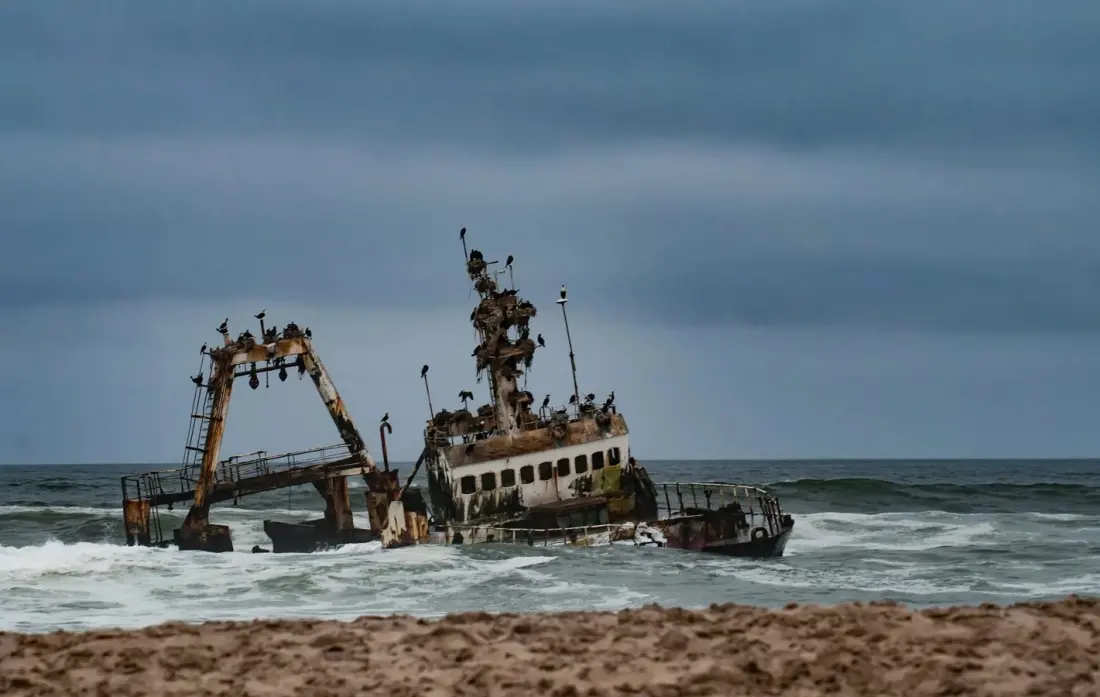
A 500km stretch of Namibian coastline has one of travel's most ominous names — and one of its strangest ecosystems. The Skeleton Coast National Park runs from the Ugab River to the Kunene River on the Angolan border, where the Namib Desert crashes directly into the Atlantic.
The name comes from the ships that met their end here. Dense fog, powerful currents and shifting sands made navigation treacherous, and wrecks still litter the shore — some half-buried in sand, others already swallowed by the sea. That fog remains the coast's defining feature, forming when moist Atlantic air hits the cold Benguela Current and rolls inland over the dunes.
Here's the surprising part: this looks like one of the emptiest places on Earth, but the fog is a lifeline. With almost no rainfall, moisture from the coastal mist sustains plants and animals that have evolved to survive on the barest hints of water. The Benguela Current also pumps nutrients into the ocean, feeding a rich marine ecosystem — most visibly at Cape Cross, just south of the park, where thousands of Cape fur seals pack the beach in glorious, noisy chaos.
The wildlife is the real head-turner. Desert-adapted elephants trek enormous distances through dry river valleys in search of food, while springbok, gemsbok, brown hyena and jackal all manage here. Lions and black rhino live in the wider Skeleton Coast and Kunene region too. The key to it all is the ephemeral rivers — the Hoanib and Hoarusib — which only flow after rain far inland. For most of the year their channels look bone-dry, yet trees and vegetation along the beds create green corridors that wildlife follows through the desert.
Exploring takes effort, which is exactly the appeal. Distances are huge, facilities thin and some areas have restricted access, so check current park regulations before you go. Self-drive 4x4 trips let you cover the empty terrain until elephant tracks or a patch of green appear out of nowhere; guided excursions make sense in the remotest sections, and fly-in safaris skip the brutal drives altogether. Key bases inside the park include Möwe Bay, Terrace Bay and Torra Bay. For a stay that leans into the drama, Shipwreck Lodge builds its cabins to look like stranded ships among the dunes. At the northern end, the Kunene River marks the border with Angola.
This one's for travellers who like their wilderness raw and their crowds minimal — a desert-and-ocean safari you can't find anywhere else on the planet.