
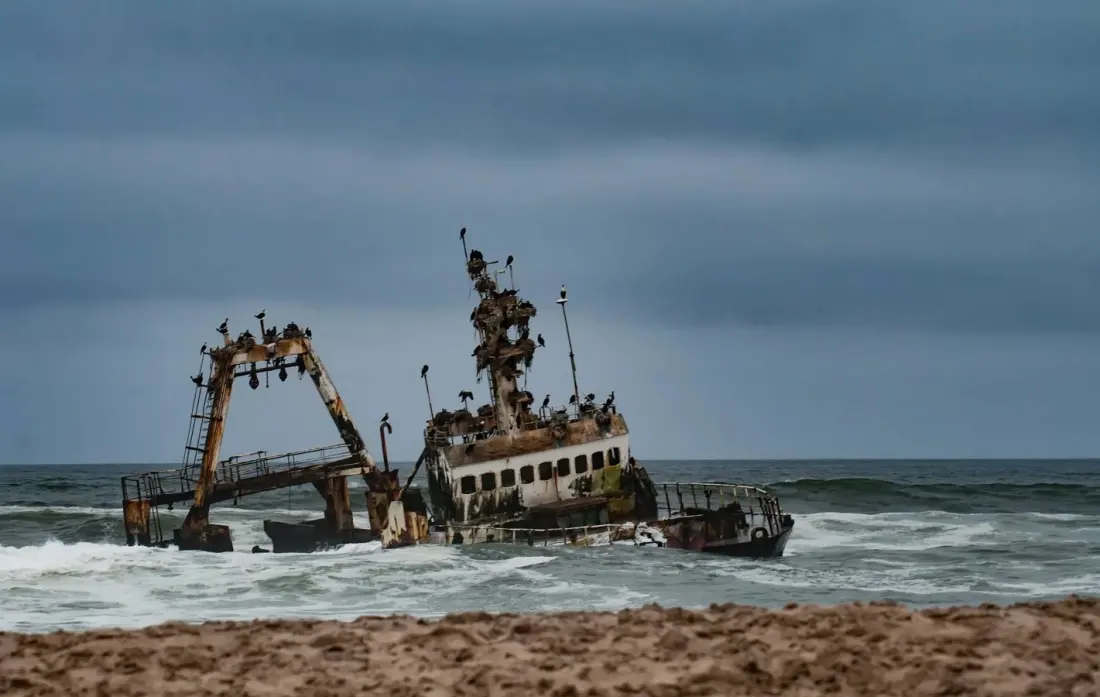
Namibia's Skeleton Coast sounds ominous, and it looks it too: roughly 500km of fog-drenched shoreline between the Ugab and Kunene rivers, where the world's oldest desert drops straight into a cold, treacherous Atlantic. The name comes from a grim tally of shipwrecks — strong currents, dense fog and shifting sands wrecked ships for centuries, and some hulks still sit stranded in the dunes like warnings.
The strangest thing about this coast is that the fog that sank those ships is also what keeps it alive. When moist Atlantic air meets the cold Benguela Current, thick fog rolls inland over the dunes. With rain almost non-existent, that moisture — plus underground water — sustains a surprising amount of life in one of the driest places on Earth.
And the life is the real surprise. This isn't a barren wasteland: springbok, gemsbok, brown hyena and jackal roam here, along with desert-adapted elephants that trek enormous distances through dry river valleys in search of food. Lions and black rhino survive in the wider Skeleton Coast and Kunene region, following ephemeral river systems like the Hoanib and Hoarusib. These rivers rarely flow — rain far inland occasionally sends water down them — but their beds carry vegetation and underground water, making them wildlife highways. Driving a 4x4 along one, you can go kilometres through empty terrain before stumbling on elephant tracks or an improbable patch of green.
The ocean half of the story is just as compelling. At Cape Cross, south of the national park, thousands of Cape fur seals pack the shoreline in one of the region's great wildlife spectacles — loud, chaotic and a vivid reminder that this is as much a marine destination as a desert one.
Practically, the Skeleton Coast rewards effort. Distances are huge, facilities sparse and some areas restricted, so check current park rules before you go. Möwe Bay, Terrace Bay and Torra Bay are the main points inside the park. Guided 4x4 trips make sense in remote terrain, and fly-in safaris skip the punishing drives entirely, dropping you at camps like Shipwreck Lodge — cabins built to look like stranded ships, which is exactly the right energy for this coast. At the northern end, the Kunene River forms the border with Angola and a fitting full stop to the journey.
This is a trip for travellers who've done the classic safari circuit and want something stranger and quieter: raw landscapes, adapted wildlife and a coastline with genuine maritime menace. Come for the elephants in dry riverbeds, stay for the fog rolling over dunes at dusk.