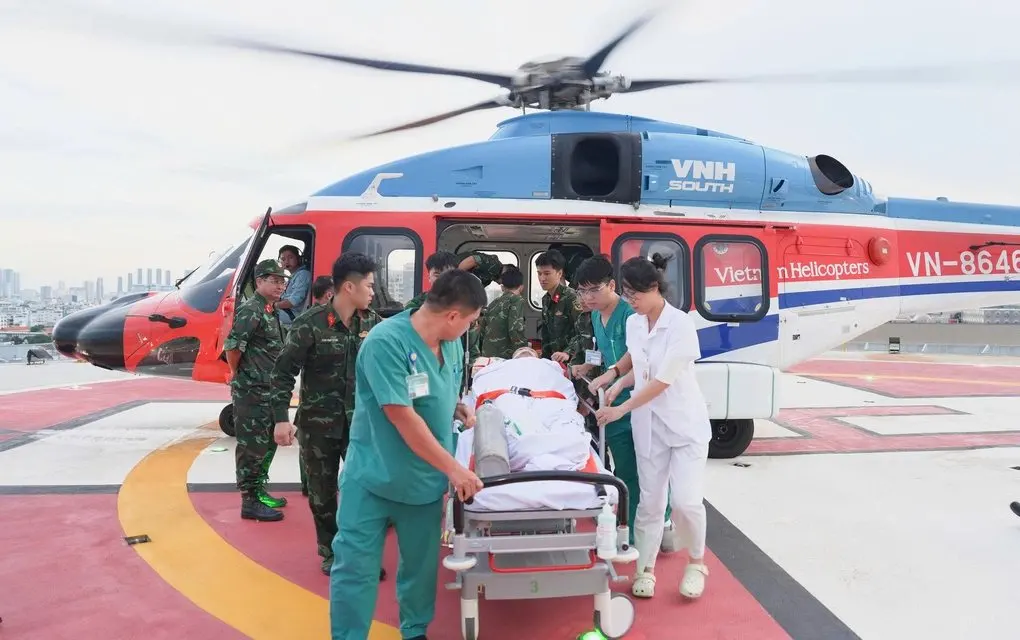
A Vietnamese worker is recovering at Military Hospital 175 in Ho Chi Minh City after one of the more dramatic aeromedical evacuations in recent memory: a helicopter flight across hundreds of kilometres of open sea to pluck him off Nam Yet Island in the Spratly archipelago.
The trouble started on November 9, when the man — stationed on the remote island for work — fell and slammed his lower abdomen into a hard object. He stayed conscious but was in severe pain, so he was rushed to the island's small medical clinic. An initial ultrasound showed no damage to the liver, spleen or kidneys and no internal bleeding, so staff stabilised him with IV fluids, painkillers and muscle relaxants, and kept him under watch.
Overnight, that watch turned anxious. His pain escalated and his abdomen began to swell. By early morning it was rigid and intensely tender — classic signs of peritonitis, or infection spreading through the abdominal lining. The island's doctors held a telemedicine consultation with Military Hospital 175 on the mainland, and together they concluded the man likely had a perforation somewhere in his digestive tract: a surgical emergency where hours matter, with real risks of sepsis, septic shock and multi-organ failure.
What followed was a coordinated operation. While hospital specialists on the mainland coached the island team through resuscitation and continuous monitoring, a helicopter from Brigade 18 took off on the morning of November 10, piloted by Lieutenant Colonel Doan Anh Tuan and carrying an aeromedical evacuation team from Military Hospital 175 led by Captain and physician Le Viet Thang.
When the team reached the island, they reassessed the patient on the spot — vital signs plus a rapid ultrasound to rule out organ lacerations, collapsed lung or blood in the chest — and loaded him aboard. During the long overwater flight he went into shock, and the onboard physicians kept him stable with vasopressors and inotropes until the aircraft landed at the hospital's helipad that afternoon. He was transferred straight to the emergency department for scans and urgent intervention, and remains in intensive care.
Why does this matter to anyone who travels? Because it's a reminder of how thin the safety net is once you're far offshore. Nam Yet Island has a clinic, not a hospital, and its lifeline is a helicopter that has to cross open sea. If your plans involve remote islands — dive boats, sailing charters, far-flung research or construction postings — it's worth checking what medical evacuation coverage your insurance actually includes, and whether it covers helicopter retrieval from offshore locations. In this case, telemedicine made the diagnosis possible at a distance, and a military aircrew made the rescue happen; for a solo traveller, knowing the evacuation chain before you go is half the battle.
Vietnam Insider