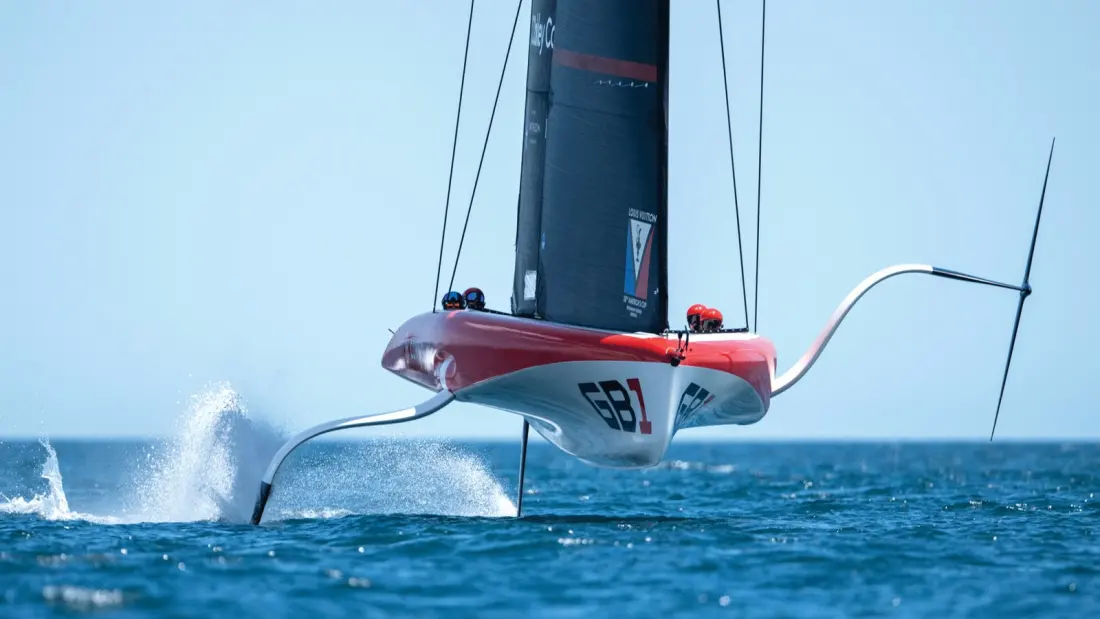
The AC40 might be the most accessible rocket ship in sailing. Launched in 2022 as the entry-level sister to the America's Cup AC75 class, this 11.8-metre foiling monohull has become the boat everyone in the Cup world is talking about — and Olympic legend Hannah Mills thinks it's the coolest on the water.
Mills, the most successful female Olympic sailor in history with two golds and a silver in the 470 class, picked the AC40 in Yachting World's 'World's Coolest Boats' series. Her description sounds more motorsport than sailing: super responsive, ripping around turns, feeling the G-forces while tucked into a cockpit. "You feel like a Formula 1 driver," she says.
The numbers back up the hype. The record top speed sits at 51.3 knots — nearly 60mph — and in race conditions crews routinely hit the mid-40s without registering it. Mills says she topped out around 46 knots, and that the sensation normalises fast: glance down mid-maneuvre and you're doing 43 or 44 knots and didn't even notice.
What makes the AC40 genuinely interesting is how it lowers the barrier to Cup-style foiling. A remarkably capable autopilot helps newcomers get to grips with high-speed flight on foils, opening a pathway for sailors who'd never have touched this technology a few years ago. There are plenty of buttons, Mills admits — she worried the electronics might dull the feel of sailing — but within a short time she was fully tuned in. And the racing format delivers: boats fly within metres of each other at ferocious speeds, which is exactly why the AC40 now underpins the Women's and Youth America's Cup events.
Mills knows the boat from the inside. She's skipper and team principal of Athena Pathway, the British Women's and Youth America's Cup squad, and also works as strategist for the Emirates GBR SailGP team.
So what's the traveller angle? If you want to see AC40s in the flesh, the 38th America's Cup match will keep the AC75 class and head for Naples, where the AC40 fleet racing around it makes a great excuse for a sailing-themed trip. And a growing number of sailing schools and simulators let everyday sailors try foiling for themselves — not in a £2.2 million Cup boat, admittedly, but the tech these machines pioneered is trickling down fast. Even if you never leave the shore, watching youth and women's teams fling these boats around a racecourse is some of the most dramatic spectator sailing ever staged.
Vital stats for the curious: 39 feet long, zero berths (this is pure racing, no cruising comfort), a record of 51.3 knots, and an 'adrenalin factor' rated at 95%. Each boat costs around £2.2 million, which is why only teams and syndicates own them — the rest of us watch, or chase foiling experiences on more humble craft.
For sailors, this is the direction the sport is heading: faster, more technical, and — thanks to that clever autopilot — more open to newcomers than the Cup has ever been. For everyone else, it's a very good reason to plan a trip around the next regatta.
Via Yachting World