Some of the most lifelike faces from the ancient world have arrived in Rome. "Egypt and Rome, the Faces of Fayum" opens this week at the city's Ara Pacis museum, pairing Italy and Egypt in a loan exhibition organisers are calling a milestone for cultural cooperation between the two countries.
The stars of the show are the famous Fayum funerary portraits: realist paintings on thin wooden panels, often just millimetres thick, that were placed over the faces of mummies between the first and third centuries AD, after Egypt became a Roman province. Instead of the stiff masks of earlier eras, these images show wrinkles, greying hair, a child's chubby cheeks, long eyelashes — people who seem to look straight back at you. Painter Amedeo Modigliani put it bluntly: these people are not dead, they are more alive than those looking at them.
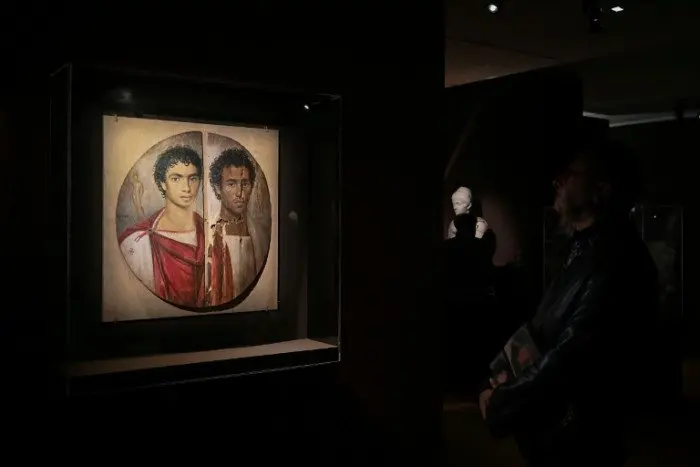
Many pieces have never left Egypt before. One is the restored "Tondo of the Two Brothers" from Cairo's Egyptian Museum, a double portrait from Hadrian's era showing two curly-haired young men that Rome's cultural heritage chief Claudio Parisi Presicce called possibly the most important painting to survive from antiquity. The Louvre has lent a near-perfect linen shroud showing a man standing between his future mummy and Anubis, the jackal-headed guide of the dead. There are mummies, masks, shrouds, marble busts and jewellery too — including the first-century woman Isidora, whose three-tiered gold necklace, pearl earrings and elaborate curls announce her status across two millennia.
The context is what makes these works so rare. They come from Fayum, a fertile region on Egypt's desert edge whose dry climate preserved fragile painted wood, textiles and papyrus that would have rotted anywhere else. And they capture a cultural mash-up: sitters with Egyptian features wearing Roman dress, painted in a Hellenistic style, during a brief window when two empires' traditions overlapped. Scholars still argue over basics — whether the panels were painted at death, made in advance, or hung in homes first (a nail found atop one portrait supports that last theory).
For travellers, this is a uncommon chance to see Egyptian treasures outside Egypt, gathered from collections including the Louvre, the Met and the Getty, in one of Rome's most striking modern museum settings. It's a compact, high-impact show — easily paired with the Ara Pacis altar itself and a stroll through central Rome — and it closes on May 2, so the window is short. Anyone planning a spring city break with a cultural anchor should build an afternoon around it.