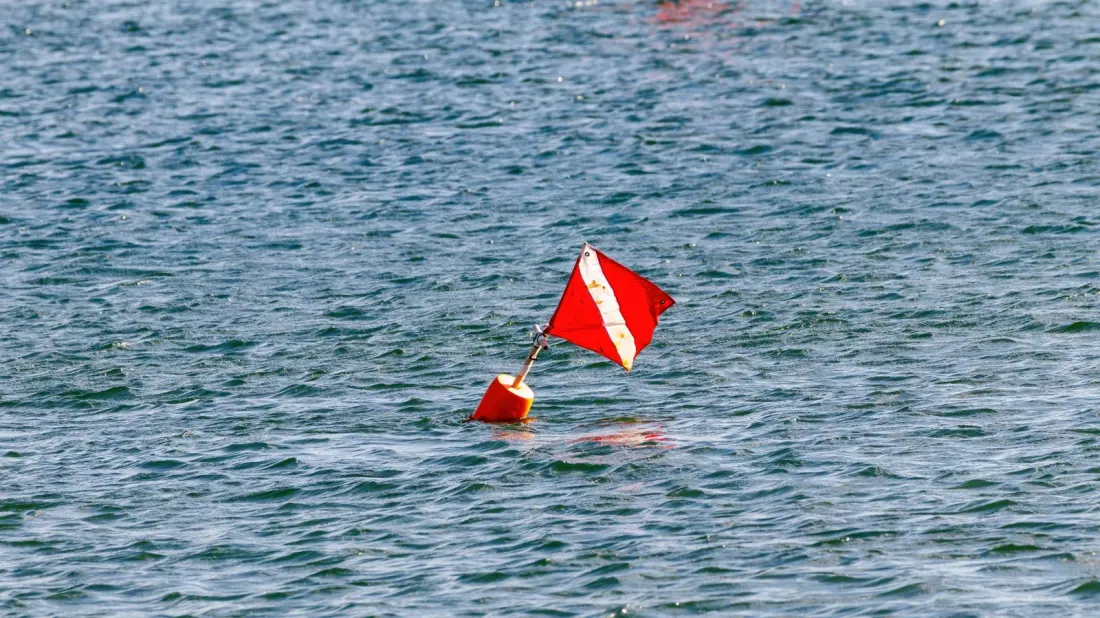
Spotting a buoy topped with a red flag split by a white diagonal stripe should make any boater, jet skier or skipper ease off the throttle immediately. That's the "Diver Down" flag, and it means there are divers or snorkellers in the water nearby — people who, from the helm, are essentially invisible.
The flag dates back to the late 1950s, when it was created by a diver looking out for his own safety, and it has since spread across the United States and most of North America. The majority of U.S. states now require divers to display it in the water. Don't expect the buoy itself to follow a set colour scheme — it can be red, white or yellow, because it's the flag doing the talking. This is also why it sits outside the standard system run by the International Organization for Marine Aids to Navigation, which governs most other buoys you'll pass on the water.
Travellers diving further afield need to know a second symbol. The Diver Down flag is not an international requirement, so you won't necessarily see it at dive sites in Southeast Asia. Internationally, boats with divers below fly the blue-and-white Code Flag Alpha. On many charters you'll see both flags used together, so it's worth recognising each before your first dive of the trip.
There's a practical split in responsibility here. Government agencies handle navigational markers — like the black-and-white-striped buoys warning of obstructed waters — but divers deploy their own dive buoys. On an organised scuba charter, the operator sets the buoy for you. Diving independently, that job falls on you, and in some places it's a legal requirement rather than a suggestion.
The buoy only works if everyone plays by its rules. According to the Divers Alert Network, divers must stay within about 100 feet of the marker in inlets, rivers and channels, rising to 300 feet in open water. Boats must observe those same distances — and crucially, they apply in every direction around the buoy, not just on one side. If you're at the helm, slowing down, giving extra room and keeping a lookout for anyone who's drifted from the flag costs you a minute and could save a life.
For holidaymakers, this matters whether you're renting a boat on a snorkelling trip in Florida, jet-skiing near a reef, or booking a liveaboard somewhere new. Learning the two flags — red with a white diagonal stripe and the blue-and-white Alpha — takes seconds and translates to any coast where people dive.