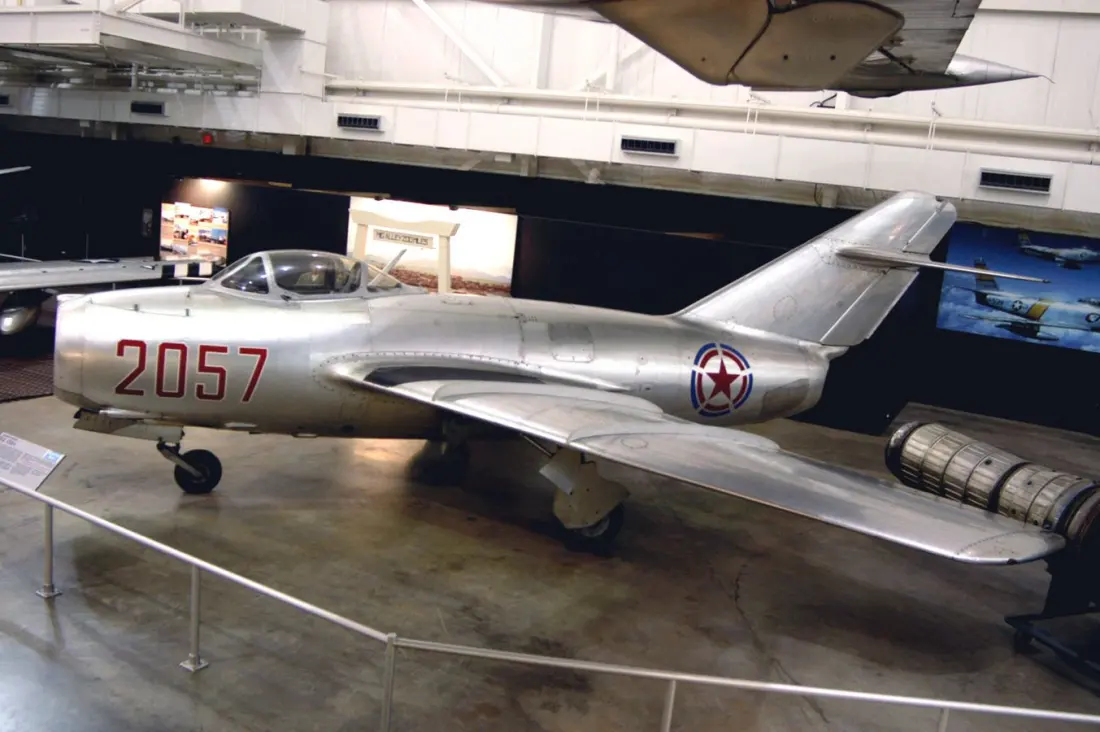
Before the MiG-21 or MiG-29 became shorthand for Soviet air power, there was the MiG-15 — a stubby, swept-wing jet that stunned American forces during the Korean War and went on to become one of the most-built fighters in aviation history. Young Pioneer Tours has pulled together a dozen facts about the aircraft, and several are genuinely surprising.
Start with the irony: Britain helped build it. In 1946, the Attlee government sold the USSR advanced Rolls-Royce Nene jet engines — supposedly for non-military use. Soviet engineers promptly copied them into the Klimov VK-1, which powered the upgraded MiG-15bis. Stalin reportedly could hardly believe the British had offered the technology at all. Within a few years, fighters built on that British engine were shooting at British and American aircraft over Korea.
First flying on 30 December 1947, the MiG-15 brought swept wings, a pressurised cockpit and an ejection seat into Soviet service. Against high-altitude bombers it was devastating: on 12 April 1951 — 'Black Thursday' — around 30 MiG-15s fell on a formation of B-29 Superfortresses, the type that had dropped the atomic bombs six years earlier, shooting three down and badly damaging seven more. The piston-engined strategic bomber, briefly the most feared aircraft alive, was suddenly obsolete.
The Soviet role in Korea was officially a fiction. Soviet pilots flew in North Korean and Chinese markings and were told to use Korean phrases on the radio — instructions that fell apart under combat, with American pilots routinely hearing Russian over the airwaves. They nicknamed the sharpest opponents 'Honchos', from the Japanese word for boss.
The West badly wanted an intact example. In Operation Moolah, the US offered $100,000 to any communist pilot who defected with a MiG-15. On 21 September 1953, North Korean pilot No Kum-sok landed his MiG-15bis at Kimpo Air Base near Seoul — apparently unaware of the reward, having fled for his own reasons. He got the money anyway, later became a US citizen as Kenneth Rowe, and his jet still sits in the National Museum of the United States Air Force in Ohio, where Chuck Yeager himself test-flew it. Two months earlier, Polish lieutenant Franciszek Jarecki had flown a MiG-15 to the Danish island of Bornholm and asylum — on the very day Stalin died.
The jet had quirks. Its two 23 mm cannons and one giant 37 mm gun were built to shred bombers, not duel agile fighters. It could be nasty to fly, with heavy controls at speed and a tendency to snap into spins. It even lost to a propeller plane: in September 1952, Marine captain Jesse Folmar shot one down from an F4U Corsair before being downed himself — he survived.
Nearly 18,000 were built worldwide, and the story ends darkly: Yuri Gagarin died in a MiG-15UTI trainer near Moscow in 1968, and in 1955 Bulgarian MiG-15s shot down El Al Flight 402 after it strayed into their airspace, killing all 58 aboard.
Why care? Plenty of surviving airframes sit in museums from Ohio to Eastern Europe, and the jet remains a fixture of Cold War-era aviation collections — a rewarding stop for anyone whose trip planning bends towards military history.
Story via Young Pioneer Tours.