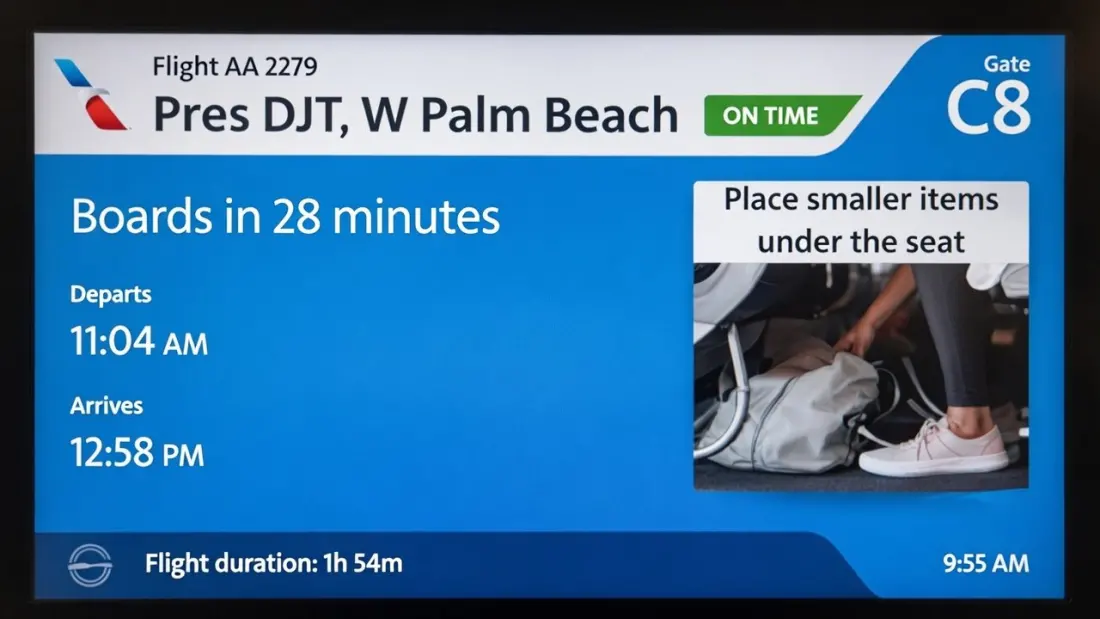
American Airlines has quietly reverted its departure screens at West Palm Beach from "Pres DJT" back to plain old "West Palm Beach, FL." The switch was spotted on Wednesday night by aviation watcher JonNYC, who noted he wasn't claiming any link to the midterm election results — and American hasn't said exactly when the change happened. But the timing is hard to miss: the tweak coincides with a shift in political power in Washington, and undoes a display treatment no other airport in American's network received.
The backstory is odd. Airlines normally show just the city name on gate monitors, adding an airport name only when it helps tell two airports apart — JFK versus LaGuardia, say. Little Rock flights don't announce Bill Clinton's airport; Grand Rapids doesn't trumpet Gerald Ford. Yet from July onward, flights to Palm Beach International were billed with the president's name, and American even armed its gate agents with talking points. An internal memo cited Florida's renaming law and the airport's changed three-letter code, saying the airline follows airport names "as determined by international bodies as well as federal, state and local governments."
That explained the airport's new name — Florida renamed Palm Beach International as President Donald J. Trump International Airport, effective July 9 — but not why the president's name needed to appear on the screen. Notably, the airport itself made no such change to its own displays. The IATA code changed from PBI to DJT on August 18, giving the airline cover, but the gate-screen treatment was American's own call.
Why does it matter? American still has plenty riding on good relations with the current administration. The Department of Transportation and the FAA regulate it heavily, and in September the airline announced plans for Alaska Airlines to join American's Atlantic and Pacific joint businesses — a deal that needs DOT approval, antitrust immunity and the administration's help winning approvals overseas. Sharing revenue and coordinating fares and schedules with Alaska and American's international partners is a big prize, so a subtle dialling-down of presidential flattery is a notable risk, however small.
For travellers, the practical takeaway is cosmetic: flights to West Palm Beach now look like every other destination on the board. The airport keeps its official Trump-era name and the DJT code, which is still worth knowing if you're booking, checking baggage tags or navigating arrivals boards — PBI references linger on older paperwork and in muscle memory. Whether the airline's retreat signals a broader cooling of corporate deference as the political winds shift is the more interesting question, and one worth watching over the next two years.