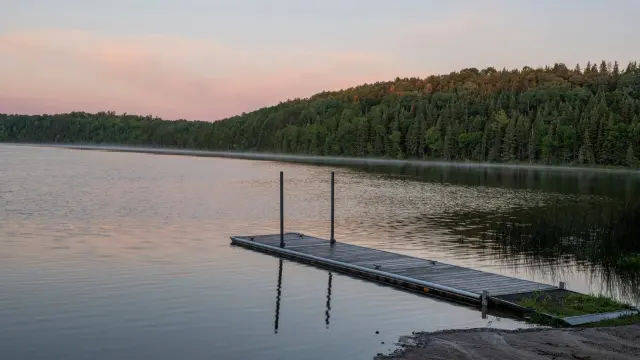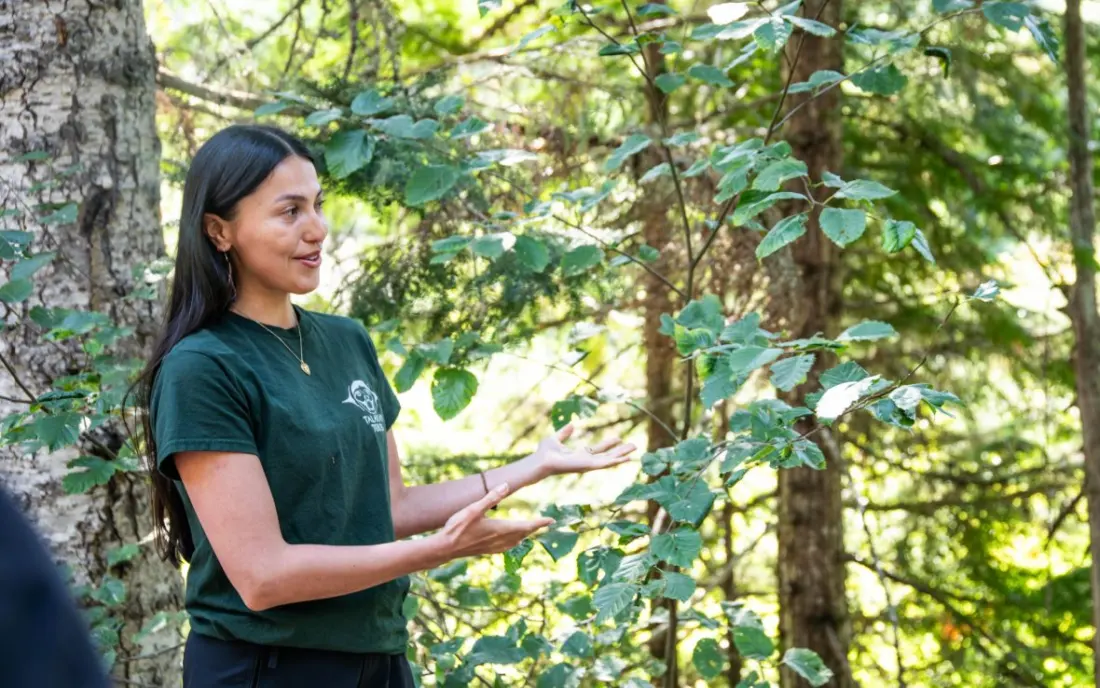
Just outside Whistler Village, on the unceded territories of the Squamish and Lil'wat Nations, a forest trail leads to Lost Lake (Sḵwiḵ) — historically a stopping point where Indigenous communities gathered resources and fished while travelling between the coast and the interior. It's here that Talaysay Campo of Talaysay Tours is previewing a new experience called 'We Are The Land', named for a phrase her aunt taught her: we are the caretakers of the land.
The walk is no ordinary nature hike. Campo, whose company was founded by her mother Candace in 2002 and is rooted in the Shíshálh (Sechelt) and Sḵwx̱wú7mesh (Squamish) Nations, points out plants like Devil's club, a woody shrub her ancestors used for pain relief, and shares hush tea brewed from raspberry leaf, mint sweet licorice root and rose hips. Her framing is blunt: with logging and climate change pressing on these forests, people won't protect land they have no relationship with.
The experience matters beyond one trail. Talaysay Tours has partnered with B Corp operator Intrepid Travel to fold this place-based learning into Intrepid's 10-day Grand Canadian Rockies itinerary from 2027. It's part of a bigger push: Intrepid aims to have an Indigenous-led experience on 75 percent of its Canada tours by the end of this year, and on every Canadian itinerary by the end of 2031. A Huron-Wendat experience in Wendake, Quebec — including a guided visit to the longhouse at the Huron Traditional Site — joins the Eastern Canada by Rail itinerary in 2027.
The demand is clearly there, even if access hasn't kept up. An Angus Reid survey of 1,507 Canadians commissioned by Intrepid found 57 percent are interested in an Indigenous-led experience, yet fewer than one in five have ever taken one. Visibility is the gap: 42 percent of those who haven't participated simply hadn't encountered one while planning, and 30 percent didn't know where to look. Meanwhile, seven in ten Canadians say they'd enjoy learning about Indigenous cultures, and more than four in ten would pick a Canadian trip that includes an Indigenous-led experience.
Intrepid is also backing this with money, committing over USD$350,000 across five years to Indigenous tourism in Canada via the Indigenous Tourism Association of Canada (ITAC), which wants Canada to be a world leader in Indigenous tourism by 2030. As Talaysay Campo notes, Indigenous tourism currently holds just five percent of the Canadian market — partnerships like this are how that changes, with communities keeping both the economic benefit and control of their own stories.
For travellers, this is a genuine shift in how you can experience Canada: not just mountains and city stops, but learning directly from the people whose territories you're walking through — and knowing your tourism dollars flow to them directly.