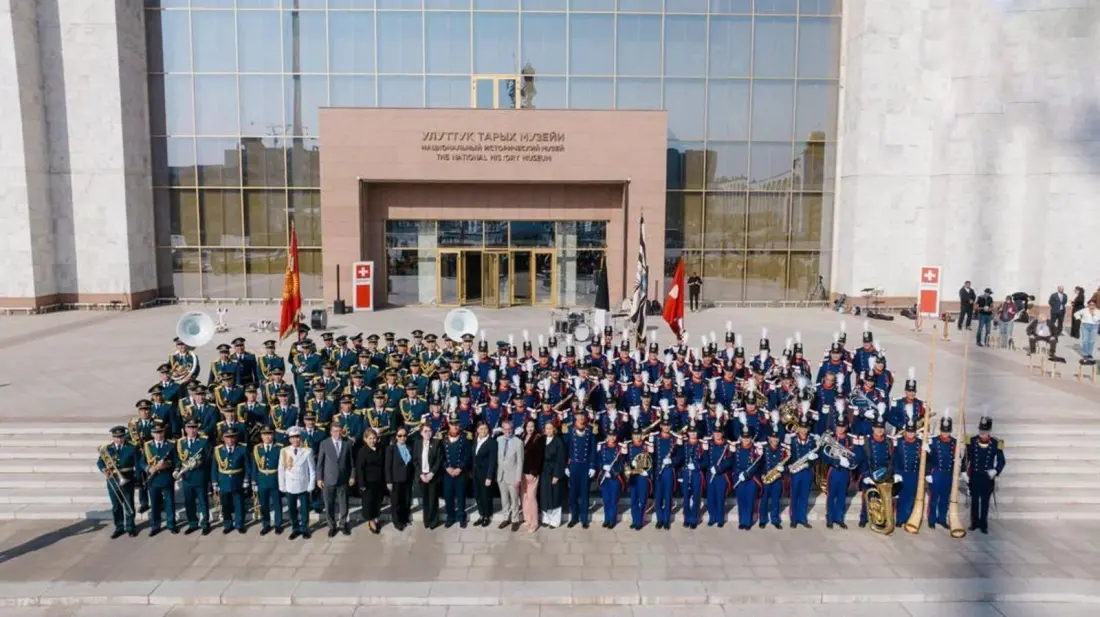
Bishkek's ceremonial streets hosted an unusual double act recently: the brass of the Orchestra of the General Staff of the Armed Forces of the Kyrgyz Republic, marching alongside Switzerland's La Landwehr de Fribourg, a wind orchestra with more than 220 years of history behind it. The joint march-past was staged during a visit by Pierre-André Page, President of the National Council of the Swiss Federal Assembly, and several members of Kyrgyzstan's parliament turned out to watch.
The occasion was diplomatic at heart — MP Gulya Kozhokulova used the moment to underline ties between the two countries across politics, the economy, energy and public administration. But the most interesting thread for travellers is the mountains. Both Kyrgyzstan and Switzerland are defined by high country, and the two governments share an interest in joint programmes for the sustainable development of mountain regions. Kozhokulova framed the performance as a "melody of friendship" between two mountain peoples.
For anyone who has been watching Kyrgyzstan's slow rise on the adventure travel map, a Swiss delegation in Bishkek is more than a curiosity. The country's alpine credentials are real: the Tian Shan range covers roughly three-quarters of the territory, with peaks like Khan Tengri topping 7,000 metres, and valleys such as Ala-Archa and Jeti-Oguz within easy reach of the capital. Swiss expertise in mountain tourism and sustainability could, over time, shape how trails, guesthouses and winter sports develop there.
The parade itself also says something about Bishkek as a destination. The capital, home to around a million people, remains one of Central Asia's most walkable and low-key cities — Soviet-era boulevards, the oak-shaded Oak Park, the vast Osh Bazaar, and a growing café scene. Military and folk performances on Ala-Too Square are a regular feature, so visitors often catch something similar without any planning at all.
Why should a holidaymaker care? Because moments like this signal where a place is heading. Kyrgyzstan is easing visa regimes for many nationalities, expanding guesthouse networks around Lake Issyk-Kul, and slowly building the kind of institutional relationships that make travel smoother. For now it remains one of Eurasia's most affordable and uncrowded mountain destinations — the Switzerland of Central Asia, as tour operators like to say, at a fraction of Swiss prices.
If the pairing of a Kyrgyz military band and a 220-year-old Swiss wind orchestra has put the country on your radar, Bishkek makes an easy starting point: fly in, spend a couple of days adjusting, then head south to Song-Kul's yurt camps or east to Karakol for trekking. The marching bands won't be on the itinerary, but the mountain backdrop they performed under will be.