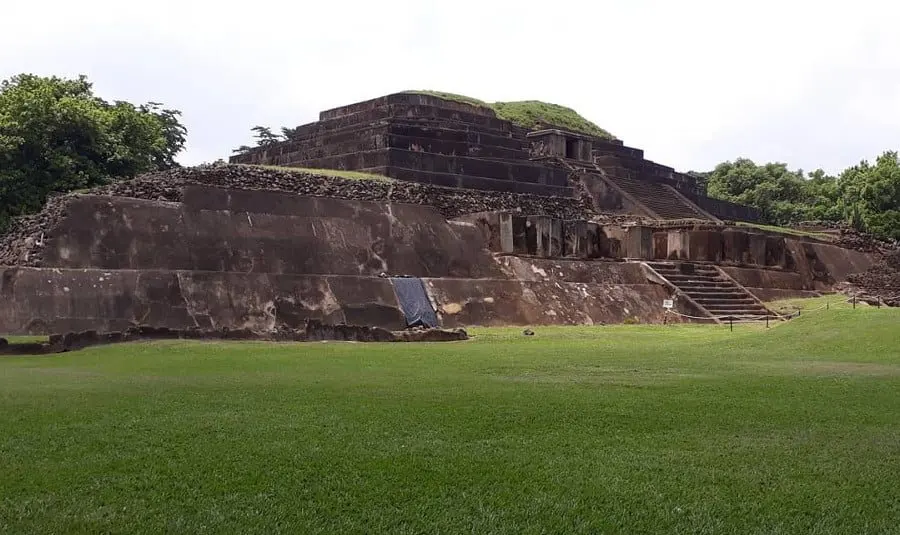
El Salvador isn't the first country most people name when Mayan ruins come up, but Tazumal in Chalchuapa makes a strong case. This pre-Columbian complex in the western department of Santa Ana is one of the country's most significant archaeological sites, anchored by a large stepped pyramid that towers over a small, walkable urban park.
People have lived in the Chalchuapa area since around 1200 BC. Tazumal itself hit its stride during the Classic period (roughly AD 250-900), when it functioned as a major ceremonial centre built in recognisably Maya style. What makes it interesting is that it wasn't an isolated outpost — pottery, carvings and architectural details found here point to trade and cultural links stretching across Mesoamerica, well beyond the Maya world. Activity at the site continued into the Early Postclassic period, which is unusually late for the region.
Much of what visitors see today is thanks to Stanley H. Boggs, an American archaeologist who led major excavations and restoration work here in the 1940s. Finds include ceramics, burial offerings and a well-known stone figure called the Virgin of Tazumal, an example of pre-Columbian sculpture that helps explain the artistic traditions of the area. The name Tazumal is usually traced to the Nahuat language — often translated as 'the place where souls are consumed' — though historians admit they're not certain.
Practicalities are refreshingly simple. The park sits inside the town of Chalchuapa, about 80 kilometres west of San Salvador, so it's an easy trip from Santa Ana or the capital by car or public transport. Entry gets you the pyramid, ceremonial platforms and plazas, plus an on-site museum displaying artefacts from the digs — worth doing first, since it gives context to the structures outside. The dry season from November to April is the comfortable window; mornings are cooler, and you'll want decent shoes, water and sun protection for the open grounds.
Tazumal also works as part of a bigger loop. Chalchuapa holds other ancient sites, including Casa Blanca and El Trapiche, the latter linked to some of the area's earliest monumental construction, so history buffs can easily fill a full day in town. Santa Ana city, with its theatre and coffee heritage, is close by, and the Ruta de las Flores isn't far either.
For travellers, the appeal is accessibility. You get monumental pre-Columbian architecture and a proper museum without crowds, without long hikes, and without venturing deep into the jungle — a rare combination in the Maya world.