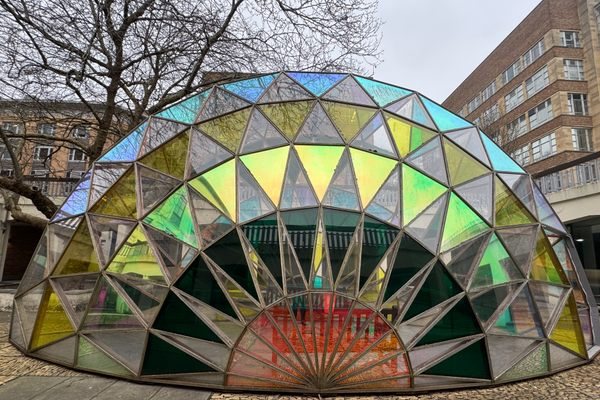
Tucked into a cobbled courtyard off Cantock's Close, just outside the University of Bristol's School of Chemistry, sits one of the city's oddest and most moving structures: the Palm Temple, a wooden, stained-glass pavilion by local artist Luke Jerram.
Built in 2020 to mark the 600th anniversary of Brunelleschi's dome in Florence, the piece eventually came home to Jerram's native Bristol, where he donated it to the university. From the outside it reads like a futuristic chapel. The trick is in the geometry: two halves of a spiralling wooden dome face each other across the space, forming the silhouette of two enormous palms pressed together in prayer. Dichroic panels throw shifting colour like stained glass, and a mirrored floor doubles the whole thing, bouncing sky and weather back up at you.
The real punchline hangs inside. Jerram's Extinction Bell rings at random intervals, between 150 and 200 times a day. Every toll stands for an estimated species lost somewhere on Earth within a 24-hour period. It turns a pretty photo stop into something closer to a memorial — you might be admiring the light when the bell sounds, and the whole mood shifts.
Because the temple is open to visitors and reacts to the elements, no two visits look the same. Bright sun saturates the panels; overcast skies mute them; rain plays across the mirrors. After dark it glows from within, which makes it an easy addition to an evening stroll through Bristol. In a city already known for Banksy-era street art and heavy-hitting architecture, this small pavilion offers a quieter, stranger pause.
It's free, centrally located near the university precinct, and takes ten minutes or an hour depending on whether you wait for the bell. Anyone with an interest in design, science, or public art will get something out of it — and it pairs naturally with a wander around Clifton, the harbourside, or Bristol's street-art trails.
Story via Atlas Obscura.