Northeastern Botswana serves up a safari pairing most travellers never consider: a night of bedroll camping on the vast Makgadikgadi Salt Pans, then a couple of days watching one of Africa's great zebra migrations from a lodge above a riverbed.
The pans are remnants of ancient Lake Makgadikgadi, a body of water that once covered more ground than Switzerland. Today the salt crusts over so heavily that nothing grows — no grass, no trees — leaving a flat, crater-like white expanse with an unbroken 360-degree horizon. In the wet season, water collects at the edges and draws in zebras, wildebeest, antelope and flamingoes; in the dry months, the pans become one of the darkest, quietest places you can sleep under canvas-free stars.
Writer Meera Dattani did exactly that on a seasonal sleep-out run by Desert & Delta Safaris, out of its Leroo La Tau lodge. Forget tents — guests get thick-duvet bivvy bags spaced well apart on the pan, with a basic toilet-and-wash-bowl setup a discreet distance away. After sunset beers and a barbecue under southern skies, the payoff is a night sky with zero light pollution: the Southern Cross and a clearly visible Milky Way, then a soft orange sunrise rising from a perfectly flat horizon.
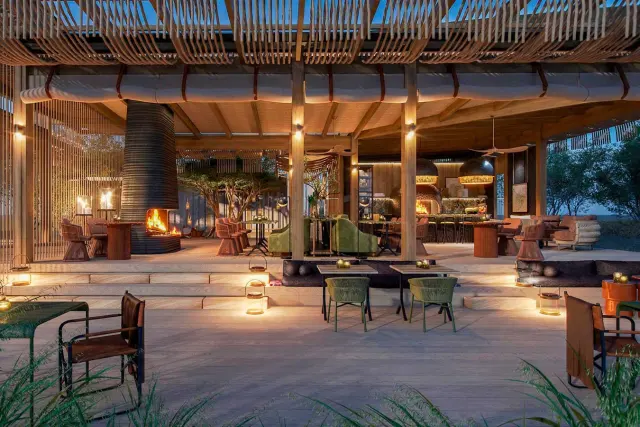
Leroo La Tau itself sits above the seasonal Boteti River on the western edge of Makgadikgadi Pans National Park. The river dried up in the mid-1990s after dwindling Okavango floodwaters, then returned with record rains in 2009. During the May-to-October dry season, its waterholes and the dry channel below become a magnet for wildlife: roughly 15,000 zebras move about 310 miles between the Okavango Delta/Moremi region and the pans, joined by wildebeest, oryx, impala, giraffes, elephants, hippos and crocodiles. The lodge's glass-fronted chalets and its riverside hide put the whole spectacle a few metres away — with staff escorting guests to their rooms after dark, because this is genuinely the edge of a national park.
The drive between the pans and the lodge can deliver surprises too. Dattani's group spotted an aardwolf — only her guide's fourth sighting in nearly 18 years — a hyena relative that hoovers up around 250,000 termites a night with a long sticky tongue.
Who's this for? Travellers who've done the classic Okavango or Chobe circuit and want something stranger and more elemental. It suits two moods: the silence-and-stargazing type drawn to the emptiest place they've ever stood, and the wildlife obsessive who wants big game viewing without peak-season crowds. Note it's a dry-season experience — the salt pan sleep-out runs roughly June to October. Desert & Delta is fully Botswana-owned and locally managed, and its conservation work acknowledges a real tension: lions that stray into villages to kill goats are often killed in return, so community education and research sit alongside the tourism. One night on the pans, two nights watching zebra herds yap like puppies at the waterhole — it's a memorable alternative to the standard fly-in safari.