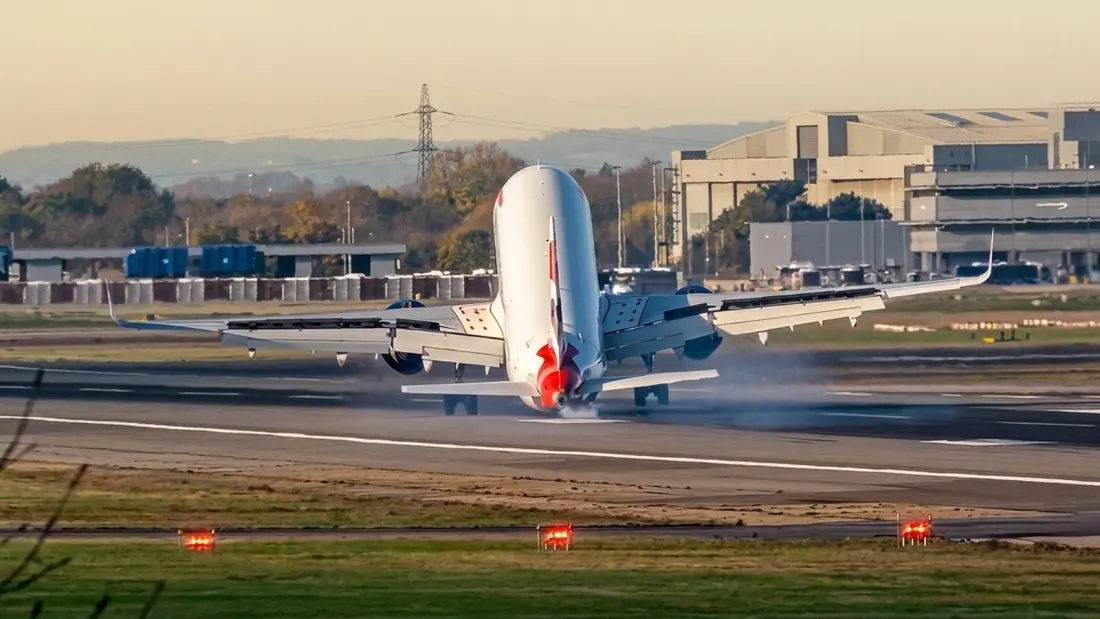
A routine hop from Amsterdam to London turned into front-page aviation news this week when a British Airways Airbus A321neo struck its tail on the runway — twice — during landing at Heathrow.
The flight, BA431, was operating the short Amsterdam Schiphol to London Heathrow route, normally a sub-50-minute rotation. On Thursday morning the jet, registration G-TNEB and just under three years old, departed Schiphol 25 minutes late at 10:45 AM. Fifty minutes later it lined up for runway 27L at Heathrow, and that's where things went wrong: as it touched down, the aircraft's tail hit the pavement on both ends of the touchdown — what's known as a double tail strike.
The crew did what pilots are trained to do in this situation: they went around. The jet climbed away to a maximum of 4,000 feet, looped back over Beckenham, and rejoined the approach near Brixton for a second attempt. This time it landed safely, touching down at 10:50 AM — 15 minutes after the first attempt. Total flight time: an hour and five minutes, well above the usual 50, and the longest the flight had taken in three weeks.
The drama didn't go unnoticed. The whole thing was captured live by BigJetTV, a popular aviation livestream, and the clip has already racked up more than 213,000 views on YouTube. The UK's Air Accidents Investigation Branch is now looking into the incident, and British Airways says it's assisting but is legally unable to comment further while that investigation is under way.
Tail strikes are taken seriously in aviation. Depending on severity, they can crack or deform the rear fuselage — one Airbus freighter suffered a tail strike at Heathrow in October 2025 and was written off entirely. That's why G-TNEB has been pulled from service for inspections that go well beyond a normal turnaround. The grounding looks short-lived, though: the aircraft isn't rostered to fly on the Friday, but is expected back on Saturday morning, starting with a London–Inverness round trip before resuming its Amsterdam and Warsaw rotations.
Why does this matter to travellers? First, it's a textbook example of a go-around working exactly as designed — the crew aborted an unsafe landing and flew a second, successful approach. Second, if you're booked on a BA A321neo route over the coming days, a temporary aircraft swap is possible, though BA has 20 of the type in its fleet, so disruption should be minimal. And third, it's a reminder that even the shortest flights — Amsterdam to London is about as routine as flying gets — occasionally don't go to plan, and the system handles it.
The investigation will determine what caused the unusually firm touchdown. Until then, the jet stays parked at Heathrow, and BA's Saturday schedule tells us the airline doesn't expect to find anything that keeps it there long.