The best underwater photos rarely come from expensive gear. According to photographer Jenny Stock, writing in Dive Magazine, the real skill is field craft: reading animal behaviour, moving slowly and knowing when to back off entirely.
Her first principle is to learn each species' body language. Sharks, for example, tend to turn away from divers hovering in mid-water, because a big vertical shape reads as a potential predator. Her fix: drop low onto the seabed and tuck yourself behind a sea fan or boulder — ideally a photogenic one, so it doubles as an intriguing foreground — then wait for the shark to close the distance itself.
Small creatures need even more subtlety. Blennies poking out of their holes will retreat when a diver barrels into their territory, so Stock's method is to stop, wait, and if nothing happens, swim off for five minutes. Shooting something of similar size and colour lets you dial in camera settings; on a second, slower approach the subject is usually far more tolerant.
Movement matters more than most divers realise — water amplifies every fin kick, and a careless burst of water can flatten delicate animals. Stock keeps her motions slow and deliberate, using her lungs to fine-tune position, and stops chasing subjects altogether. Fish get curious, mantas carry on their natural paths, and crabs feed right in front of your lens. With sea lion pups at Jurien Bay Marine Park in Western Australia, she didn't approach at all: the pups raced over on their own, fascinated by their reflection in her dome port, and produced far better photo opportunities than any pursuit could.
Patience pays. A mating mandarinfish shot requires diving at dusk and hovering near their den for a brief window when a pair rises and releases eggs and sperm — behaviour shots feel intimate precisely because they capture a moment in an animal's life rather than proving its existence.
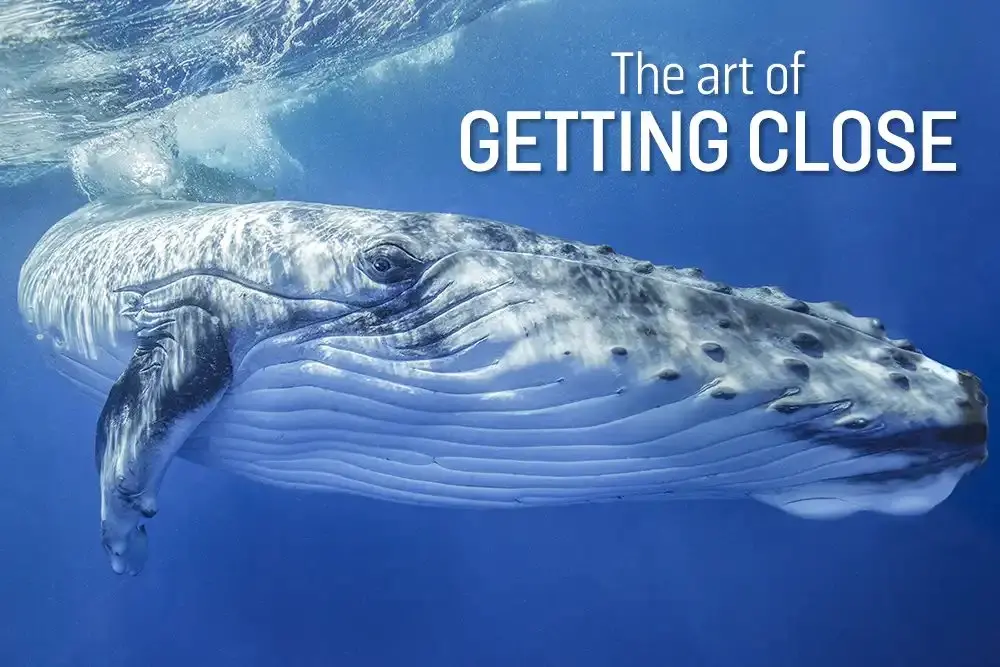
Local knowledge is the other half of the equation. In Vava'u, Tonga, guide Sioni Fifita taught Stock to position herself near a humpback whale's head, in the mother's line of sight and away from the dangerous tail. If a mother deliberately placed herself between diver and calf, that meant back off. In Ambon, Indonesia, guide Lucky Nampasnea needed ten dives to trust a photographer's buoyancy before revealing a half-centimetre orange amphipod hidden inside a purple tunicate — subjects that demand powerful stacked macro lenses and pinpoint spatial awareness, since one clumsy move could crush the animal.
There's an ethics thread running through all of it. Stock argues animal-initiated interaction isn't automatically harmful — the key question is who controls the encounter. But she's seen photographers chase mantas, block mantis shrimps' escape routes and reposition seahorses for the shot, and warns that publishing manipulated-looking images normalises behaviour others will copy.
Her final advice is the least glamorous: know when to walk away. Sometimes the animal simply isn't interested, and no amount of technique changes that. The most rewarding images, she says, are the ones where you know you were briefly allowed into an animal's world without changing it.
For anyone heading off on a dive holiday with a camera, this is a genuinely useful primer — applicable whether you're shooting reef macro in Indonesia or whales in Tonga.
Thanks to Dive Magazine for the original piece.